Change is constantly occurring as the information from contacts in my network demonstrate.
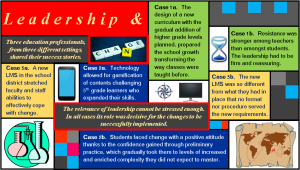
LRNT525 Leadership n Change Infographic
Case 1. Change of curriculum & expansion of grade levels.
This is the case of an EC-9 school that had plans to expand to an EC-12 school. The identity of the school and the people involved shall remain undisclosed. Usually changes to the school’s curriculum even when mildly complex might require some adjustment in addition to teachers’ training. In this case the new curriculum represented a serious challenge: first, the content of all subjects would be organised differently; second, the classes would be oriented to be hands-on learning; and third, the teachers would act as coaches allowing the learners to be in the driver’s seat.
The initiative for this change came from the school’s principal, and it took a great effort on every level to get it started. To begin with there was the school board to approve the project. Then administration and, most importantly, faculty had to adopt the idea because organisational readiness is fundamental for a change effort to be successful in any organisation (Weiner, 2009). Parents had to understand the project’s vision and the commitment needed to succeed. And last but not least, the student body had to be involved too due to each adolescent having their voice heard at home regarding where to study high school. Existing high schools increased the challenge of the project.
Several factors were key for the success of the effort. Training teachers to perform in a maker-space setting helped them break paradigms to accept and experience innovation. Active involvement of students included them participating in the design of a new cafeteria which gave them sense of ownership towards the new high school.
As Weiner asserted it: “The content of change matters as much as the context of change” (Weiner, 2009) could not have summarized the project better, and without the intense leadership exerted by the school’s principal the effort would have failed.
Case 2. Gamification.
As they enter the room, the students in Mr. Magallon’s 5th grade class ask the question right after greeting their teacher: “Do we get to play Kahoot! today?” Kahoot! is a free game-based learning platform that makes it fun to learn – any subject, in any language, on any device, and for all ages (2018).
Mr. Magallon regarded the gamification successful because oftentimes previously unengaged students ask him for a Kahoot! link to play at home. He then realised game-based made a difference. Kahoot! got students plugged into learning, helped them improve mastery of complex science topics, fostered social learning, unlocked learners’ potential, and deepened pedagogical impact (2018).
Leadership was modelled by Mr. Magallon when he played with the students for the first time. Kahoot! is played in teams rotating the leader role, who coordinates the team and voices their answers supported by the team-debated arguments for which the students practiced collaboration skills. By placing the learners in settings that make them think critically to solve problems or arrive to solutions, game-based learning becomes as effective as project-based learning (Farber, 2016).
Case 3. New Learning Management System.
Although the need of a new Learning Management System (LMS) was obvious, the change took most teachers and staff by surprise because the system became operative a few days before the first day of classes which meant the old system to be gone.
It took the principal, the assistant principal, and the computer lab teacher a lot of hours to provide in-classroom support to every teacher in campus in order to get the school running with the new LMS. Names not to be disclosed.
Due to the sudden start the only training available was on the fly, and the difference people was having started as early as calling attendance, which now was done with the system. Pen-marked rosters sent to the office before 9:45 a.m. were a thing of the past.
At some point during the daily support of teachers, the principal instructed his team to concentrate on aspects of the LMS that were essential to the school’s daily operation, and forget about other features not needed in the short term. The principal followed a strategy that resonates with Feldstein (2017) who described that any LMS is likely to be built as a series of add-ons to an original idea, which ends up saturated with added features that cause the core functionality to be hidden somewhere. Miller (1982) postulated that an incremental approach can be a cost-effective manner of facing change that provides for stages of stabilization, and this resembles what the principal asked his team to do.
References
Farber, M., (2016). Gamify your classroom. The Education Digest 81(5), 37-42.
Feldstein, M., (2017, May 28). A flexible, interoperable digital learning platform: Are we there yet? [Blog post].
Magallon, D., (2018). E-mail to Alfonso Mac Gregor, sent from Sam Houston Elementary at P.A.I.S.D., Port Arthur, TX.
Miller, D., ( 1982 ). Evolution and revolution: a quantum view of structural change in organizations. Journal of Management Studies 19(2): 131 – 151.