I started my journey of exploring educational technology (Ed Tech) by looking at its history and definition. I associated Ed Tech with computers and the internet, but I was wrong. I learned that the history of Ed Tech goes far beyond that. According to (Haran, 2015) Blackboards books, sandbox, slates, hornbooks, film, radio, television, teaching machines, microcomputers, and the internet were all kinds of Ed Tech that have been used throughout the years.
I also was surprised to find several definitions associated with the wide EdTech field as there is no one agreed-upon definition but rather several definitions from different perspectives.
(Edutech wiki, n.d.) provides several perspectives to look at Ed Tech. One of them is the instructional design (ID) perspective. In a previous post in my blog, I shared that I am interested in ID. Therefore, I have used this perspective to look at Ed Tech.
I have learned that Ed Tech is synonymous with pedagogy, learning, and ID. The following picture shows us the components of ID models and how EdTech is part of the tools and methods used in ID.
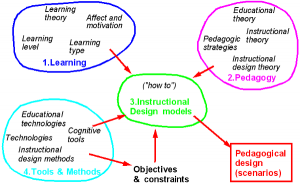
ID links EdTech to the learning theories, pedagogical theories, and strategies. ID learn from human information processing, cognitive load, and metacognition as these theories explain the relationship between learning type, learning level, and pedagogic strategy. (Edutech wiki, n.d.)
Per (Wikipedia, n.d.) The person who works in EdTech is someone who tries “to analyze, design, develop, implement, and evaluate processes and tools to enhance learning” (para. 3). The term educational technologist is used in the United States, learning technologist is synonymous and used in the UK as well as Canada.
(Merrill, Drake, Lacy, & Pratt, & Research Group 1996, para. 12 ) have provided an interesting distinction between instruction and ID. They have argued that ID is a technology founded in the science of instruction and ID is a combination of (1) set of scientific principles and (2)technology. Technology is used in ID to implement these principles in order to create an instructional environment.
References
Educational technology. (n.d.). In Edutech wiki. Retrieved September 4, 2019. From http://edutechwiki.unige.ch/en/Educational_technology
Haran, M., (2015, May 29. A History of Educational Technology [Blog post]. Retrieved from http://institute-of-progressive-education-and-learning.org/a-history-of-education-technology/
Instructional Design Space.png (n.d.). Educational Technology. [Picture]. Retrieved from http://edutechwiki.unige.ch/en/File:Instructional_Desing_Space.png
Merrill, M. D., Drake, L., Lacy, M. J., Pratt, J., & ID2 Research Group. (1996). Reclaiming instructional design. Educational Technology, 36(5), 5-7.
Wikipedia contributors. (2019, September 4). Educational technology. In Wikipedia, The Free Encyclopedia. Retrieved September 4, 2019, from https://en.wikipedia.org/w/index.php?title=Educational_technology&oldid=913966465

September 5, 2019 at 10:56 am
Interesting how nebulous the history of EdTech is…even to simply define it becomes a challenge. Thanks for sharing your findings!
September 8, 2019 at 10:27 am
I started my journey of research with the same thoughts – that I already had a good understanding of ed tech’s history, but you point out that that thought is way too restrictive; it’s not all about the micro computer wave of evolution, but instead embodies a wide range of ‘technologies’!
September 8, 2019 at 12:53 pm
Hi Tala, thank you for sharing your thoughts on ID through a diagram. Your diagram illustrates that digital tools are for supporting/supplementing learning activities, and the design should be anchored in research and theories.
September 13, 2019 at 8:26 pm
Hi Tala, I enjoyed your blog on Educational technology & design perspective. Thank you for sharing the insight on the topic. The illustration about the pedagogical design was especially of interest to me. I agree that Instructional design has been undergoing significant changes resulting from developments in areas including pedagogy, learning science, and technology.
I am curious to find out do the general rules of education hold value for contemporary online ( e-learning) pedagogy? Also, you shared your interest in ID, would that be in the field of Academics or the business world, because the application and expectations of ID are very different in different fields.
September 14, 2019 at 12:40 am
Hi Tahreem,
Thank you for your comment 🙂 I really cant answer your first questions as I am no expert in this field. I am trying to learn as much as I can. Maybe at a later stage, I will be able to answer your question as I learn more and understand this field.
As for my interest in ID, I am interested in ID specifically in the higher education sector (dictance learning). I wonder if this interest will be maintained after I complete my MALAT journey!