

On this Easter weekend, with family visiting from France and my mother in isolation due to rising COVID cases in her community, I’ve struggled to meet these deadlines. I’m here now though and have just realized as I write this that I have been using our chosen technology for a while.
The issue that we are interested in exploring is Augmented Reality (AR) in education. The technology sounds amazing and has a lot of promise, but like a lot of technology, there are downsides, or rather risks that need to be managed. My experience with AR so far is limited to work travel. I traveled to The Netherlands in 2019 for work. I speak absolutely no Dutch, so I downloaded the Dutch language package for Google Translate on my cell phone. Some of the translations were a little off, as this warning about a step down in a hotel restaurant shows (Figure 1).
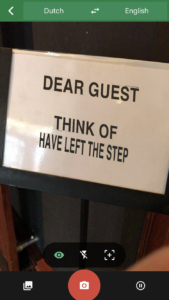
Figure 1. Warning in hotel restaurant. Houldsworth, 2019.
What I learned from other translations was deeper, as shown by this poster in the Resistance Museum. I invite readers to use their own application, whether Google Translate or a different one, to translate this happy family image and let me know your thoughts on its intent.

Figure 2. World War 2 German propaganda poster. Verzetsmuseum Amsterdam, taken 2019.
The ability of a machine to communicate powerful ideas in live time intrigued me. At the same time, the strange translations showed me that the technology is only as good as its inputs. When I helped my in-laws download the same application this weekend so that they can be more independent as they travel around our very anglophone town, the looks on their faces as they realized the power of the application was tempered by the privacy warnings that Google includes when the user gives permission to save conversations and photo translations.
Ostensibly, Google wants to improve its translations and algorithms, but with that comes the need to allow Google access to users’ searches to provide training for the algorithm. Depending on what the user inputs, Google potentially has access to some very private information. Hotly debated in whether a massive company like Google, with such huge market share, is fairly using users’ data and providing equitable results (Cossiavelou, 2018). Also risky is the quality of translation when the application is used for critical instructions. According to one paper, “Google Translate has only 57.7% accuracy when used for medical phrase translations” (Patil & Davies, 2014), which leads us to conclude that machine translations are not yet as good as or better than human translators.
Our team, the Extendables, have decided to choose Augmented Reality (AR), or rather Extended Reality (ER) (hence the team name!), for our learning event and delivery technology. Our group chose a relatively new application called Jigspace that was created by an Australian duo in 2014. Since then, Jigspace has developed quite a few impressive networks using their technology, most recently with Alfa Romeo. Jigspace wants users to be able to create a team with which creators can share 3D information. The paid version of the software uses uploaded Computer Aided Design (CAD) files, common in design and manufacturing, to render 3D images that the application can project onto a camera’s viewer. The images projected wind up looking very much like Pokémon GO images,but instead of cartoon monsters, users can explore how a toaster works, or how an Alfa Romeo Formula 1 (F1) racecar works. A recent software update has also added sound files so that users can hear how the Jig, as the output is called, sounds. I look forward to exploring more about Jigspace’s evolution, its current uses, and its future plans, as well as trying to exploit its weaknesses.
References:
Cossiavelou, V. (2018). Global Regulations in Content Industries: The Google Privacy Policy as a News Gatekeeping Factor. International Journal of Interdisciplinary Telecommunications and Networking, 10(3), 9–20. https://doi.org/10.4018/IJITN.2018070102
Patil, S., & Davies, P. (2014). Use of Google Translate in medical communication: Evaluation of accuracy. BMJ, 349(dec15 2), g7392–g7392. https://doi.org/10.1136/bmj.g7392
Team posts:
Paula: https://malat-webspace.royalroads.ca/rru0221/investigating-the-reality-of-virtual-reality/
The wording on the poster says, “prosperity in your family by labor in Germany”. It was propaganda for Dutch families, encouraging them to sign up to move to Germany to work and earn wages. In fact, the program was a forced labor program that only revealed itself once the families arrived. For me, to learn this in live time using AR at the Resistance Museum in Amsterdam was more moving than it would have been if I had just looked at the exhibits, which were all in Dutch.
https://en.wikipedia.org/wiki/Forced_labour_under_German_rule_during_World_War_II
You provide a great example of how much technology still needs to live up to its hype, such as the translations. And even when it’s working well, as you note the privacy implications are huge and the question is to what extent do we need to be concerned in education? How do such platforms gain entry into our institutions? Good questions to explore.
Ok so Corie. I don’t know anything about history. It’s like groundhog day in my brain. I learn history and the next morning it’s gone. I need to google again but the challenge you posed here with the poster I had to take up so is the intent of the poster to enocurage families to move from Germany to Denmark? My app said the translation is
“prosperity in your family through work in dutchland” so was Germany intending to send families to Denmark to work but for German purposes? The translation inconsistencies are challenging still to invoke the correct meaning aren’t they?
Language can be so nuanced also in terms of the meaning behind choosing certain words to convey humour or sarcasm for instance. I do tend to be reactive to privacy concerns but also co-constructing meanings with translation apps in AR sounds so cool. The possibilites of co-constructing using AR for language translation and conveying meaning seem so helpful. I think about having a translation for instance like the poster above where the meaning is not clear to me in the clunky translation but if say another user could convey their understanding using an AR tech add on to the translator so there was a connnectivism element that could become more multi-dimensional and perhaps more meaningful language learning.
Thanks for your comment Karen! It was a Nazi propaganda poster trying to entice Dutch citizens to voluntarily move to Nazi Germany where they could get “good” jobs and “provide” for their families. What happened was that the Dutch that did avail themselves of the “offer” found themselves in work camps, forced to work for the Third Reich as indentured labor (because they “signed up for” the program). Part of Germany’s messaging at the time was around pointing out how similar the Dutch and German languages and cultures are, so that any Dutch resistance to the Nazi occupation would be discouraged. It was ultimately a failure from a societal level, but on a personal level, many families were sucked into the scheme and ruined.
You hit the nail on the head when you pointed out how nuanced language can be. AI in language applications is tough without cultural expert oversight, a fact I became acutely aware of when trying to explain the difference between Catholicism and Protestantism to my in-laws! In French! I feel like I didn’t do it justice – imagine how much poorer an app would have done without the human touch!