The following design principles were created from my professional experience in technology, evidence-based on the readings of this and previous MALAT courses, as a result of reflecting in the process undertaken by my partner and myself during the design thinking challenge, as well as peer feedback provided. These design principles were also created with a social constructivism approach and with the human element of learning in mind. According to Kim (2001), “social constructivism sees as crucial both the context in which learning occurs and the social contexts that learners bring to their learning environment” (p.4).
References
Brown, A. & Green, T. (2018). Beyond teaching instructional design models: exploring the design process to advance professional development and expertise. Journal of Computing in Higher Education, 30(1), 176-186. https://link.springer.com/article/10.1007/s12528-017-9164-y
For this activity, we were tasked to think about our “design superpowers” and how we utilize them in our current practice. I found this to be an enlightening exercise since it made me think deeply about those soft skills and personality traits that are a reflection of our feelings, behaviors and thoughts. All those things that we probably do every day without even thinking about it.
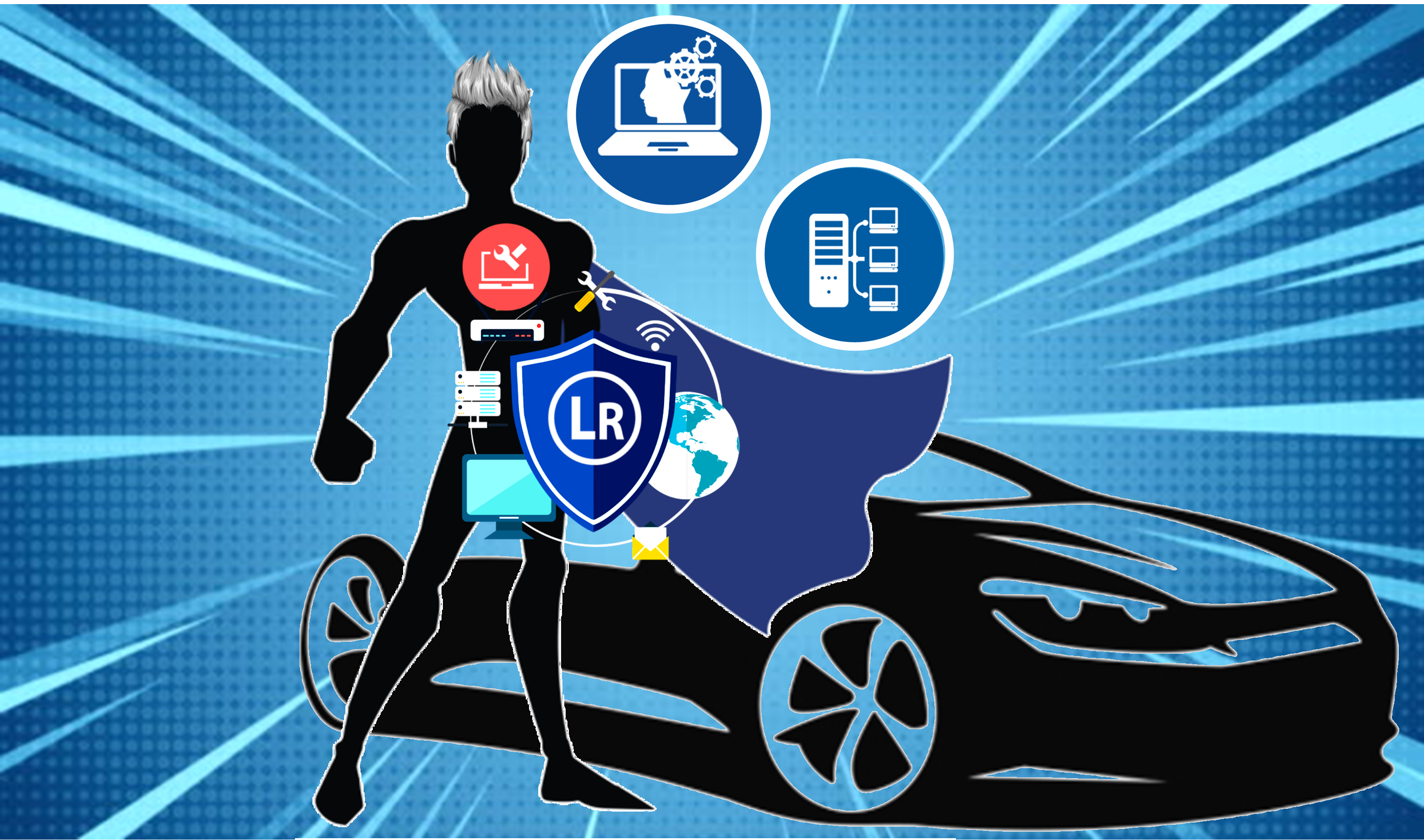
Stefaniak (2021) states that instructional designers are tasked with making countless decisions in every project they complete, with that in mind, I have designed an illustration that represents my current role as a technology manager of an automotive group which has brought together two of the things that I have always been passionate about: vehicles and technology. Here are some of the “superpowers”, computer-based ID tools and methodological ID tools (Lachheb and Boling, 2018) that I have identified in my current practice:
X-ray vision – Having a good eye for detail and great ability to analyze any situation. Whether it is a website design or video creation/editing, the final product has to be absolutely professional and exceptional! The tools I use for this superpower are: WordPress, Adobe creative cloud, Filmora, Microsoft Publisher and several online and mobile applications.
Precognition – Being proactive and having security measures in place before threats and villains come invading our businesses. For this superpower I rely on tools that I install or monitor such as Antivirus software, security and alarm systems, domain servers, backups, more backups and backups of the backups.
Techno kinesis – Working with a variety of analog, digital and electronic devices. Debit machines, printers, phone and camera systems, WiFi and LAN network configuration, DMS, email management, website third-party integrations, and server setup and maintenance to name some.
Teleportation – Working in different projects and in different cities across BC at the same time requires someone with the ability to manipulate space and time. The most valuable tool I have for this superpower is a program called Screen Connect, it allows me to remote in to any PC so I can provide technical support to multiple users at arguably the same time.
References
Lachheb, A., & Boling, E. (2018). Design tools in practice: instructional designers report which tools they use and why. Journal of Computing in Higher Education, 30, 34-54. Retrieved from: https://doi.org/10.1007/s12528-017-9165-x
The objective of this paper is to critically examine two instructional design models used for the creation of digital learning environments. An analysis of their origins, strengths/weaknesses and their application in digital learning environments will be provided. The chosen models for this purpose are the PIE and ADDIE models.
The PIE Model
In 1996, Newby, Stepich, Lehman and Rusell authored together a book for educators titled Instructional Technology for Teaching and Learning where they first introduced the concept of the Instructional Design (ID) model known as the PIE Model. The name of this model comes from the identification of three main phases: Planning, Implementing and Evaluating (PIE). It focuses “on classroom instruction created and delivered by the same individual or small group with an emphasis on using media and technology to assist them” (Gustafson & Branch, p.44). The PIE model is a classroom-oriented model that was primarily designed to shift the classroom focus from teacher-centered instruction to student-centered instruction with an emphasis of implementing technology in each of its phases. In this model, each of these phases is essential to developing an effective instructional plan.
The Planning phase of the PIE model is to identify learning objectives and to prepare the lesson (or course). It includes gathering information and making decisions about what should be included in each lesson. Instructors need to review the resources and analyze the environment by gathering information about the learners’ prior knowledge of the lesson. Instructors also need to know what students are to learn, and how, why and when it would be best accomplished (Dousay, 2017). By identifying learning objectives, analyzing the learner and the content, the instructional designer can create an outline of the learning experience that will lead to the desired learning outcome. During this stage, there is also an emphasis in place on how technology can be used to motivate students to learn and to make the planning and instruction more efficient.
Implementing is the second phase of PIE; it is the part of the lesson where instruction is actually occurring. The focus is on applying the instructional plan using instructional materials, technology and media. This phase “addresses various forms of media and methods with a particular focus on how the computer can be incorporated into lessons” (Gustafson & Branch, p.46). During the implementation phase, students experience the “where, when and how” of learning, while instructors monitor and manage a classroom of diverse learners. Instructors need to plan for it, they need to know how to maintain classroom control, how to keep learners engaged and motivated, and how technology can be used to increase the impact of instruction.
Evaluating is the third and final phase of the PIE model. The focus of this phase is on evaluating student learning and assessing the effectiveness and efficiency of the lesson. “Evaluation includes both learner performance and how the data can be used to continuously improve their own and student performance” (Gustafson & Branch, p.46). During this phase, teachers reflect on the instructional plan to compare its outcome to the initial desired goal. Instructors reflect on the quality and quantity of learning compared to their initial expectations. They also take the time to analyze the issues they encountered in each phase of the instructional design process and determine a way to improve it for future use.
One strength of the PIE model is the focus on teacher reflection during the evaluation phase. Teachers not only measure the effectiveness of the lesson but also reflect throughout each phase of the instructional design process on what was successful and what needs improvement. Another strength of this model is its focus on integrating educational technology in all phases of the design process. “PIE combines the analyzing, designing, and developing phases into a singular focus area” (Dousay, 2017).
One disadvantage of PIE is that there are only three phases for this design model leaving a lot of room for interpretation in between phases for those planning the instruction and working on the design process. Because this model is mainly focused for a classroom-oriented environment, one weakness is the limited amount of revision and tryout time since the lesson is actually tested the same day of its implementation.
The ADDIE Model
ADDIE is a design model that has its origins in military training and distance education (Bates, 2015). It is one of the most popular models that provides learning designers a strong foundation and basic structure for designing training material for any learning environment. This ID model “has been almost a standard for professionally developed, high quality distance education programs, whether print-based or online” (Bates, 2015). Gustafson and Branch (2002) also identify ADDIE as a conceptual framework for ID models. ADDIE is a model widely known and utilized by instructional designers that consists of five sequential stages or phases:
Analysis. During this phase, the instructional problem is identified, instructional designers gather information about the audience, their training needs and their learning goals to which the instruction will be targeted to. In this phase, instructional designers also look at what resources are required and available.
Design. In this phase the learning goals are transformed into clear learning objectives. Some of the activities created during this stage include storyboards, rough drafts and prototypes of printed and digital media are created as well.
Development. It is when creation of the content and learning materials happen. Videos and voiceovers are recorded and edited. Designers and developers decide whether to develop materials in-house or to outsource them (Bates, 2015).
Implementation. It is when the actual delivery of instruction occurs. Learners are ready to take the course and they have access to the materials created for that purpose.
Evaluation. During this phase, data is collected and reviewed with the objective to find out if the initial instructional problem that was identified during the Analysis phase has been resolved and if the learning goals and objectives were accomplished.
One advantage of the ADDIE model is that it is a generic and simple model that can be applied to create any type of learning experience for any audience in any instructional situation. One strength of ADDIE is that it has been used as the foundation for other ID models and it is considered a proven method for designing effective training programs.
Although ADDIE and PIE are similar in some of their phases, PIE has “general rules that you can adapt to fit each situation, rather than a rigid procedure that you must follow in the same way every time” (Newby et al, p. 81) while ADDIE, due to its sequential nature, it is considered by some designers to be too linear, too detailed and inflexible. “While no single model is useful for all settings and all purposes, it is important to identify the intended focus of an ID model and the context for which it is intended” (Gustafson & Branch, p.31).
References
Bates, T. (2015). Chapter 4.3 The ADDIE Model.Teaching in a Digital Age: Guidelines for designing, teaching and learning.
Newby, T. J., Stepich, D., Lehman, J., & Russell, J. D. (1996). Instructional technology for teaching and learning: Designing, integrating computers, and using media. Merrill/Prentice-Hall.
For this activity, we have been tasked to read about Instructional Design (ID) models and to connect theory and practice by sharing our thoughts of a design model that we have used within our work environment. I have to admit that my knowledge about ID models and learning environments is not very extensive, so reading and learning about it from the foundational level has been a very enlightening experience to me. Needless to say, due to my unfamiliarity with the topic, making decisions to choose a specific design model would be out of my comfort zone.
ADDIE is a widely known and utilized design model whose name stands for Analyze, Design, Develop, Implement and Evaluate. It is a 5-step process that instructional designers use to create technology-based courses. This design model is widely used in large and complex teaching designs and according to Bates, the ADDIE model “is also a very useful management tool, allowing for the design and development of large numbers of courses to a standard high quality” (2015). The Pompt’s OKT model is another design model used in the Netherlands and it is very similar to ADDIE with the difference that it “adds testing/revising the instructional solution prior to full implementation” (Dousay, 2017).
After reading about many different ID models, I can conclude that there is not an “all-in-one solution”. With that in mind, the ADDIE model with its strong foundation and proven results while it can be utilized to have consistency in education, in my opinion, it can also create barriers to innovation and openness to change in the corporate e-learning and training world. Just like Bates argues “it can be too predetermined, linear and inflexible to handle more volatile learning contexts” (2015). I also think that in the private sector, the learner’s profile, the cost-benefit, and the expected business outcomes are the fundamental considerations that have the biggest influence on choosing an ID model.