
Activity 9-1 | Reflection

Image Source

For the last few weeks in LRNT 528 I had the opportunity to observe, collaborate and even co-facilitate an entire week of online activities. After revisiting and reflecting on my original 3-2-1 Blog Post I realized that some of my original thoughts and questions have somewhat shifted.

THREE initial thoughts about facilitation in digital environments

  • I still believe that facilitation in digital environments goes beyond the integration of technologies in training processes or just giving virtual presentations. In fact, for the last four weeks it was clear that we all have different perceptions and chose different delivery methods for our facilitation week activities.
  • Facilitation in digital environments is challenging and I found very valuable taking the role of a learner to become a better facilitator. It gave me a different perspective and appreciation to the what an online facilitator does.
  • There are many new tools and platforms available today, while it is hard to keep up with all of them, they give us an opportunity to stay current with new trends and technologies.

TWO questions you have about digital facilitation

  • As facilitators, how do we measure success in the delivery of an online course? Is it only by grades? Engagement and participation? Attendance to synchronous sessions?
  • As learners, do we really provide helpful and constructive feedback to improve future deliveries of the course?

ONE metaphor

Digital facilitation is similar to how we choose, drive, and keep our vehicles. They both come with some personal taste and character of course. However, some people choose old and classics while others prefer the latest models with the most technology available. Some people like driving their cars “fast and furious” while others drive them “slow and steady”. Lastly, some like to keep their vehicles shiny and clean while others prefer to keep them a bit messy. As mentioned in my initial post, when you are the facilitator, you are on the driver’s seat; you own it, you maintain it, and you try to keep it in tip-top shape!

Facilitation Week | OEP Reflection

Image Source

This week, we explored the interesting world of Open Education and through some activities, we had some good discussions about Open Educational Practices (OEP) and Open Education Resources (OER), as well as we were tasked with reflecting on the applicability of these concepts in our own contexts.

After completing this week’s readings, one takeaway for me was that Open Education is, at its core, sharing freely and with open access. Free in the sense that OER are offered free of charge, with freedom of use, and open, to a certain degree, allowing everyone to reuse and modify them.

Open learning is changing the way people can access education and training opportunities, whether for professional development or personal interest. I think that it is important that open learning products are designed with good quality, to facilitate a good and effective experience for the learner(s) that strengthens the acquisition of new information and skills while offering different learning paths, according to their interests and needs.

Assignment 1 | CoI Facilitation Strategies

Infographic created using Power Point and Canva by Rodriguez, 2022 .

For this assignment, we were tasked to create an infographic around the Community of Inquiry (CoI) model along with some strategies to build effective online learning environments in our professional contexts.

After reflecting on my professional experience, I chose a conveyor belt to use as part of my infographic. While I anticipate the spark of a little bit of controversy about this choice, I hope that by sharing a little bit about my context I can help mitigate some of the negative connotations around conveyor belts and education.

As most of you know, I work in the Automotive sector, a fast-paced industry where I provide technical support to a group of businesses in BC (4 car dealerships, a Bodyshop, a Bicycle shop, and a Powersports store). I also make decisions about technological changes and implementations as required by the manufacturers and tackle all the day-to-day support requests. With endless requests from multiple locations, I try to deliver prompt support and implementations in a fast, efficient, and structured manner, thus my connection with the conveyor belt.

Creating Cognitive presence

I strive to always create a positive work atmosphere. While I take care of the technical aspect of things, one strategy to create cognitive presence is to listen actively to our staff members. I consider their input very valuable, at the end of the day, they know better than anyone how to run their department. I am always open to implementing new ideas and I am always happy to accommodate them in order to achieve the expected outcome(s).

Creating Teaching Presence

To establish a teaching presence, when implementing new technologies, the expected outcomes are discussed and staff members are encouraged to participate in the process(es). While I take care of the technical aspect of things, each department is responsible to learn the new processes and utilize proper hardware and software for their daily operation. There has to be a commitment to learning and not debating. I encourage staff members to embrace technology and its benefits even if in the beginning is a little bit challenging, in the long run, it is worth it. In many cases, this embracing is not even optional, it is mandated by our OEM manufacturers.

Creating Social Presence

Having a positive work environment also promotes positive interactions amongst peers. and knowing that ‘the door is always open’ for further communications that could help improve processes within the company is essential. “Facilitating social interaction fosters engagement and a sense of trust, safety, and familiarity such that social presence may emerge” (Vaughan et al., 2013). By allowing everyone the opportunity to speak their mind, share their thoughts, and make suggestions about important changes in the organization we aim to build a community of trust where everyone feels safe and included in the decision-making process.

As facilitators, we can be the conveyor belts, durable and reliable machines whose mission is to move supplies, materials, and any other components in a very efficient way and facilitate the delivery of all these supplies. Conveyor belts also require maintenance and servicing to operate properly. By staying up to date with the new technologies and being lifelong learners, we, as facilitators can ensure the delivery of a positive and engaging educational experience to our learners.

References

Bull, B. (2013). Eight roles of an effective online teacher. Faculty Focus. https://www.facultyfocus.com/articles/online-education/eight-roles-of-an-effective-online-teacher/

Vaughan, N. D., Cleveland-Innes, M., & Garrison, D. R. (2013). Chapter 3: Facilitation. In Teaching in blended learning environments: Creating and sustaining communities of inquiry (pp. 45-61). Athabasca University Press. https://read.aupress.ca/read/teaching-in-blended-learning-environments/section/43261c4a-6d4c-44cf-8c7f-60bc306eb03a

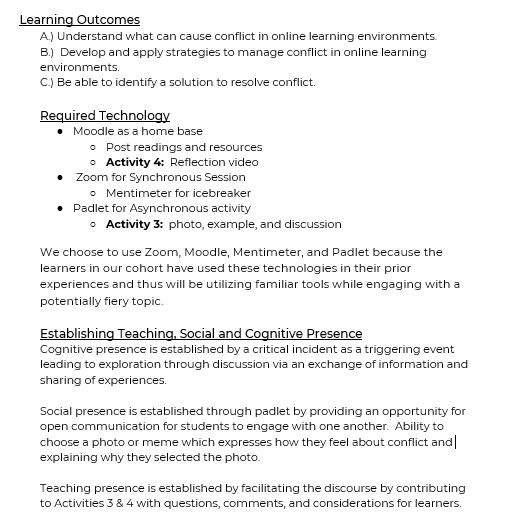
Facilitating a learning experience | The Draft

by Gail Yee, Amber Donahue, London Coronica & Luis Rodriguez

Image Source


Readings for Learners to Select from:

  • Managing Controversy in the Online Classroom

https://www.facultyfocus.com/articles/online-education/online-course-design-and-preparation/managing-controversy-in-the-online-classroom/

  • Disruptive Pedagogy and the Practice of Freedom

https://cdpcollection.pressbooks.com/chapter/disruptive-pedagogy-and-the-practice-of-freedom/

  • Social Media and Conflict: Understanding Risks and Resilience

https://www.mercycorps.org/sites/default/files/2021-08/Assessing-Digital-Conflict-Risks-Resilience-073021.pdf

  • Types of Conflict and Good solutions

http://www-usr.rider.edu/~suler/psycyber/conflict.html

Video

How to Understand the Sources of Conflict

Podcast

https://podcasts.google.com/feed/aHR0cHM6Ly9hbmNob3IuZm0vcy8yZjhjODA4Yy9wb2RjYXN0L3Jzcw/episode/NTkyMDEwMzctYjliOS00Zjg4LWE0ZmYtZTZkMWEyYWQ3MTQ5?sa=X&ved=0CAgQuIEEahgKEwjI4_mI_f75AhUAAAAAHQAAAAAQoQQ

3-2-1 Digital Facilitation

Image Source

THREE initial thoughts about facilitation in digital environments

  • I think that facilitation in a digital environment goes beyond the integration of technologies in training processes or just giving virtual presentations.
  • Digital facilitation comes with its own challenges and concerns that need to be overcome by learners (students) and facilitators to achieve the common goal of collaboration.
  • Digital learning environments take for granted a certain level of digital literacy and proficiency from both learners and facilitators.

TWO questions you have about digital facilitation

  • As a facilitator in a digital environment, how can you know if a student has understood the lesson and propose exercises and content that are adapted to their level of understanding?
  • How can a facilitator encourage individual active participation and group collaboration in digital learning environments?

ONE metaphor

Digital facilitation is like driving a fancy new car. It has all the basic components that older cars have such as the engine, wheels, brakes, and windows but also comes with many more features, bells, and whistles than previous models. Digital facilitation has its foundation and “basic components” in traditional learning and has evolved by adopting new technological “features”. You cannot go back to older models but you can decide how equipped you want your car to be and how fast you want to drive it; as a facilitator, you are in the driver’s seat.

Image Source