The Design Thinking Process
In this assignment, we were asked to develop evidence-based design principles from our reflection and peer feedback on our design thinking challenge. To summarize Kirk & Messier (2022), the outcome of the design thinking challenge was a virtual, open-ended, and constructivism-based (as cited in Heaster-Ekholm, 2020) model titled Digital Water Cooler Teacher Professional Development Series. The prototype was designed in the context of the Immigrant Services Society of British Columbia (ISSBC) in the Language and Career College (LCC). In essence, educators would construct their own development while building their digital toolkits to virtually engage with their newly immigrated students. I must denote that the design principles in this paper differed from those introduced in Kirk & Messier (2022) to include my individual reflection on the decision-making process (Cable, 2015) within the design.
Design Principles
These design principles were developed from my professional experience in human resources as well as my work on the design thinking challenge.
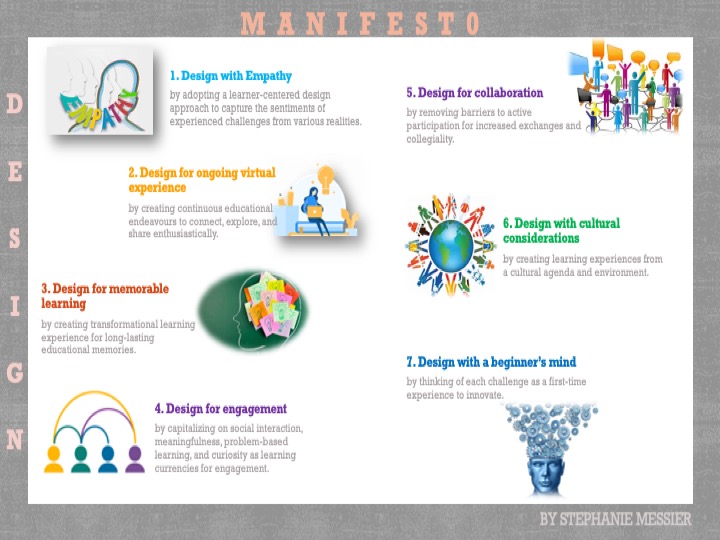
- Design with Empathy
Brown & Green (2018) discussed the need for instructors to genuinely appreciate the learners’ feelings about their realities so the design can reflect their environment to create powerful experiences. As a further thought for empathy, Donahue & Keating (2022) stated that the visualization of teachers’ working in silos in Kirk & Messier (2022) is a reminder that the isolation felt by teachers in their digital learning environment could also be felt by their own students. It would be empathically ideal if designers strive to create online learning spaces that are safe places to share. Essentially, design with empathy is adopting a learner-centered design approach to capture the sentiments of experienced challenges from various realities.
- Design for ongoing virtual experience
Weller’s (2020) connectivism and Ryberg & Georgsen’s (2010) digital literacy framework are factored into this second guiding principle that educators should have some digital skills to create connections online. Donahue & Keating (2022) further pointed out that “educators and students do have some competency in digital tools, although they may not see the education value in them yet” (para. 3). It may explain, in the context of the LLC school, that the struggles teachers have with virtual settings do not imply that they cannot teach online. Design for ongoing virtual experience, in the spirit of connectivism (Weller, 2020), is my belief that creating online educational endeavours to connect, explore, and share will generate enthusiasm for both instructors and learners alike, despite their level of digital literacy.
- Design for memorable learning
Going against the grain dimensionally was at the core of Kirk & Messier’s (2022) design model. This design principle is meeting its objective “to shift the mentality around professional development (PD) to something authentic and driven by water cooler moments of scuttlebutt and sharing” (Donahue & Keating, 2022, para. 5). One dimension of this design belief rests on Veletsianos’ (2011) lasting impression from learning events that involve interactivities that resonate with the learners. As such, Donahue & Keating (2022) suggested the inclusion of subject matter experts (SMEs) to introduce online tools as part of the PD program. Another dimension for lasting impression is to involve the teachers in negotiating the objectives of the virtual PD program as “decision-making is itself a learning process” (Weller, 2020, p. 116). Design for memorable learning aims at creating transformational learning experience for long-lasting educational memories.
- Design for learner engagement
Capitalizing on social interaction, meaningfulness, problem-based learning, and curiosity can be the learning currency to obtain learner engagement. Ornelles et al. (2019) discussed social interaction and problem-based context as key elements of adult learner engagement. Sparking curiosity can be prompted through an interest for a topic within a Community of Inquiry (CoP) (Orcutt & Dringus, 2017). Designing for engagement also involves finding meanings in the teaching by generating the belief of making a difference in the world (Veletsianos, 2011). By rooting constructivism (Heaster-Ekholm, 2020) to improve their pedagogical and digital skills, the LCC teachers could also find purpose to “become leaders in their profession” (Veletsianos, 2011, para. 11). This learning engagement currency belief is a future investment of design in practice.
- Design for collaboration
The design for collaboration principle is encouraged by Donahue & Keating (2022) “to increase sharing, collegiality and community” (para. 4) while bearing in mind that it may be “challenging to encourage authentic collaboration and reflection when working with learners who lack experience and/or motivation when working in digital learning environments” (para. 6). Although the Kirk & Messier’s (2022) open-ended design had no collaborative artifact yet, it did reference Ergulec & Zydney’s (2019) collaborative strategy as an integral part of the PD program that is also informing that collaboration is difficult when learners are facing obstacles. Accordingly, this principle is based on the concept that designing for collaboration starts by first removing barriers to active participation for increased exchanges and collegiality.
- Design with cultural considerations
Heaster-Ekholm (2020) provided considerations in support of this principle. First, the instructor must consider culture as a key element of learning by allowing connections to occur amongst learners for meaningful experiences. For instance, focusing too much on eliminating bias from the design will take away from embracing cultural differences. Next, each individual approaches a problem and solution with their own and unique interpretation. Hence, the designer must consider the importance of diversity as “learning and knowledge rest in diversity of opinions” (Weller, 2020, p. 116). The LCC school has a rich diversity which can be leveraged as part of the teachers’ PD program and subsequently, in the own course curriculum to benefit their students. Design with cultural considerations can be accomplished by creating learning experiences from both a cultural agenda and environment.
- Design with a beginner’s mind
Svhila (2017) stated that when working in the same environment for so long, it is difficult to innovate. We have a natural tendency of exploring within then environment we know. Fortunately, Donahue & Keating (2022) reminded us of Morris’ (2018) “beginner’s mind” (para. 31) of exploring without existing knowledge and truths. The adoption of a beginner mindset requires a conscious effort to develop a pedagogical design, intentionally and critically, from an open-ended inquiry (Morris, 2018). To illustrate, the design thinking challenge produced a creative tension between a partner within a framework of knowledge and truths, and a partner outside of the framework. The first partner adjusted to a beginner mindset by rethinking each challenge as a first-time experience and the design outcome was viewed as transformative.
In conclusion, these design principles reflect the decision-making process of the design thinking challenge, and they are supported by the literature, the peer feedback, and my professional experience. It was certainly an inquisitive exercise to craft design principles as they reflected a mix of elements such as personal values, emotions, and beliefs. I used Morris’ (2018) beginner mindset to accomplish this work and I am pleased with having a set of design guiding principles as a checklist for a consistent learner experience (Cable, 2015) for future in practice. A manifesto representing a synopsis of each principle is attached to this document.
References
Brown, A. H., & Green, T. D. (2018). Beyond teaching instructional design models: exploring the design process to advance professional development and expertise. Journal of Computing in Higher Education, 30(1), 176-186. https://doi.org/10.1007/s12528-017-9164-y
Cable, S. (2015, June 18). Design Principles – a guide. Cxpartners. https://www.cxpartners.co.uk/our-thinking/design-principles
Donahue A., & Keating, E. (2022, January 5). LRNT 524 assignment 3a: Design thinking challenge. Moodle. https://moodle.royalroads.ca/moodle/mod/forum/discuss.php?d=830357
Ergulec, F. & Zydney J. (2019). A design case for implementing a collaborative strategy for online teams. International Journal of Designs for Learning, 10(1), 25-34. https://scholarworks.iu.edu/journals/index.php/ijdl/article/view/24120/32666
Heaster-Ekholm, K. L. (2020). Popular instructional design models: Their theoretical roots and cultural considerations. International Journal of Education and Development Using Information and Communication Technology, 16(3), 50–65. http://ijedict.dec.uwi.edu/viewarticle.php?id=2882
Kirk, S., & Messier, S. (2022, January 2). Digital water cooler professional development series for teachers [Video]. Sam’s Blog: A MALAT Student Blog. https://www.canva.com/design/DAEzyLaPVoU/sfrex0sqPErWAA7mu04N7g/watch?utm_content=DAEzyLaPVoU&utm_campaign=designshare&utm_medium=link&utm_source=publishsharelink
Morris, S. M. (2018). A Call for Critical Instructional Design. https://www.seanmichaelmorris.com/a-call-for-critical-instructional-design/
Orcutt, J. M., & Dringus, L. P. (2017). Beyond Being There: Practices That Establish Presence, Engage Students and Influence Intellectual Curiosity in a Structured Online Learning Environment (EJ1154155). https://files.eric.ed.gov/fulltext/EJ1154155.pdf
Ornelles, C., Ray, A. B., & Wells, J. C. (2019). Designing Online Courses in Teacher Education to Enhance Adult Learner Engagement (EJ1244981). ERIC. https://eric.ed.gov/?id=EJ1244981
Ryberg. T., & Georgsen, M. (2010). Enabling digital literacy. Nordic Journal of Digital Literacy, 2(5). https://www.idunn.no/doi/10.18261/ISSN1891-943X-2010-02-02
Svihla, V. (2017). Chapter 23. Design Thinking and Agile Design. In R. West (Ed.), Foundations of Learning and Instructional Design Technology (1st ed.). https://edtechbooks.org/lidtfoundations/design_thinking_and_agile_design
Veletsianos, G. (2011). Designing opportunities for transformation with emerging technologies. Published in Educational Technology, 51(2), 41-46. https://viurrspace.ca/bitstream/handle/10613/5056/designing-opportunities-transformation-emerging-technologies.pdf?sequence=1&isAllowed=y
Weller, M. (2020). 25 Years of Ed Tech. Athabasca University Press.
Leave a Reply