The COVID-19 pandemic has accelerated knowledge work being conducted remotely and many individuals in these roles will continue to prefer working virtually (Malhotra, 2021). Various organizations I am supporting in human resources are moving toward hybrid work environments and they are seeking my guidance to promote collaboration for team engagement. Some of the leaders in these organizations have shared with me that employees are not seeking collaboration opportunities. In fact, the current virtual work reality has decreased team collaboration because of overscheduled meetings, individualization of priorities, isolation, fatigue, and blurred home/work boundaries.
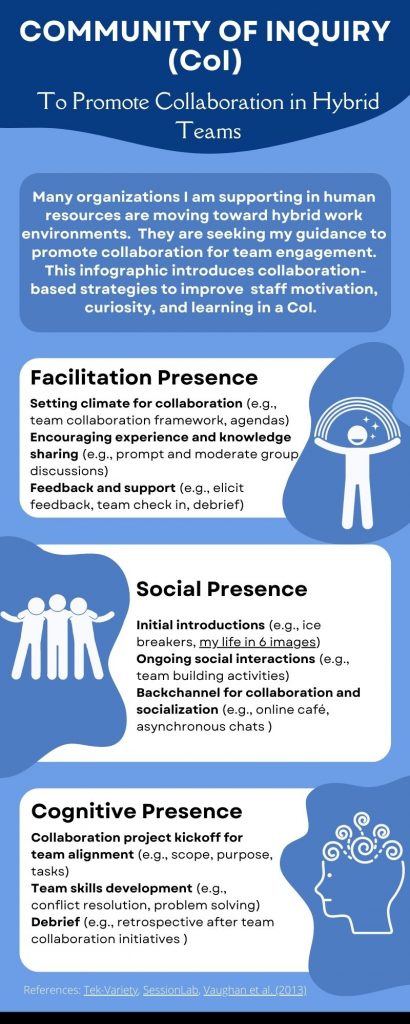
Given that collaboration is a skill that many organizations expect from their employees in the 21st century (Mashek, 2022), my Community of Inquiry (CoI) introduces collaboration-based strategies to improve staff motivation, curiosity, and learning in each element of the CoI. The dilemma I was facing with each strategy and its related activities is the consideration for the existing challenges (e.g., overworked workforce, decreased motivation) facing organizations. Therefore, the thinking behind each proposed collaborative activities considered the extraneous cognitive load to avoid further implications (e.g., fatigue, overworked) while focusing on interactivity to stimulate social presence (Khoo and Bonk, 2014).
To start, the strategies in the facilitation presence promotes a climate of collaboration as an introductory setting to stimulate learning, and then instill curiosity through experience sharing and prompts, that will hopefully motivate teams through continuous feedback and support (Vaughan et al., 2013).
Along with facilitation, the social presence ensures that team members have an opportunity to interact by getting to know each other, build relationships through their collaborative effort, and then keep their social momentum (i.e., backchannel). I created an activity named ‘My Life in 6 Images’, a simple exercise that stimulates socialization and curiosity. As a facilitator, I often encourage the group to ask at least one question of a team member’s ‘Life in 6 Images’ to encourage conversation and knowledge making.
And finally, the strategies I introduced in the cognitive presence involve skill development and retrospective after a collaborative experience. The facilitator role is central to design skill learning for successful collaboration such as problem solving and conflict resolution skills (Mashek, 2022). My objective with cognitive presence is to build meaningful and purposeful activities through sustained communication, practical inquiries, and collaboration to increase curiosity and motivation in the same fashion as Garrison et al. (2001).
I am looking forward to hearing your thoughts and feedback on my infographic.
References:
Garrison, D. R., Anderson, T., & Archer, W. (2001). Critical Thinking, Cognitive Presence, and Computer Conferencing in Distance Education. American Journal of Distance Education. https://www.tandfonline.com/doi/abs/10.1080/08923640109527071
Khoo, E. G., & Bonk, C. J. (2014). Chapter 1: Introducing TEK-VARIETY (PDF) (pg 7-12). Adding some TEC-VARIETY: 100+ activities for motivating and retaining learners online (PDF). Open World Books. http://tec-variety.com/TEC-Variety_eBook_5-4.pdf
Malhotra, A. (2021). The postpandemic future of work. Journal of management, 47(5), 1091-1102. https://journals.sagepub.com/doi/full/10.1177/01492063211000435
Mashek, D. (2022, June). Collaboration is a key skill. So why aren’t we teaching it? MITSloan Management Review.
https://sloanreview.mit.edu/article/collaboration-is-a-key-skill-so-why-arent-we-teaching-it/
Vaughan, N. D., Cleveland-Innes, M., & Garrison, D. R. (2013). Teaching in blended learning environments: Creating and sustaining communities of inquiry. Athabasca University Press. Chapter 3: Facilitation (pp. 45-61). https://read.aupress.ca/read/teaching-in-blended-learning-environments/section/43261c4a-6d4c-44cf-8c7f-60bc306eb03a
September 16, 2022 at 3:20 pm
Thank you for your insightful post, Stephanie.
I like how you are aware that many employees are not looking for more team engagement due to burn out. This is true of my organization yet our management does not seem to be very aware of this. I am curious to know if you have had enough time to notice any improvement or changes in engagement. I remember when we worked on our Water Cooler assignment, you understood that it was important not to add too much to everyone’s already busy schedule causing further cognitive overload. When I create activities now I try to create learning and sharing together rather than always top-down and not come with too much of a plan or schedule to allow for co-learning.
Thank you for sharing!
Sam
September 20, 2022 at 1:12 pm
Hi Sam, finding the right balance is difficult so you almost need to understand the individual needs to then create the right amount of engagement; still, you will always have some that will not be fully collaborating and I guess, it is just something we have to learn to live with. Thanks for your comment!
September 18, 2022 at 6:31 pm
Hi Stephanie, I find your comment about virtual work actually decreasing in collaboration extremely interesting. I have also noticed this as more and more ‘meetings’ move online. I wonder if this is a trend other fields are finding as the move to work-from-home has taken away the ability to casually run into each other, or chat over the coffee pot. I feel that these in person opportunities are where a lot of work collaboration actually happens as people build an in-person relationship with their coworkers through small activities.
Thank you for your insight and your great infographic!
September 20, 2022 at 1:10 pm
Hi Emma, thank you for your comment. Yes, unfortunately, that is the experience I have with a decrease in collaboration since individuals are working virtually. It is a patterns in many industries. I just read recently about the quiet quitting in which individuals are just doing their job but not really engaging with others. Employers know that collaboration is important but they don’t know where to start. This is definitively a topic to explore further.
September 21, 2022 at 12:43 pm
Hi Stephanie,
I love your 6 images activity. It is amazing how much you can learn about someone in just six images.
I am interested in learning more about the “quiet quitting” phenomenon you mentioned. I have been seeing this for a while and now that we have put a name to it and created some awareness we can begin to work on the problem. Is this going to be part of your final research project?
Melissa
September 21, 2022 at 5:33 pm
Hi Melissa,
I love this activity of 6 images. So impactful. Here’s one article on quiet quitting that you may be interested in https://www.gallup.com/workplace/398306/quiet-quitting-real.aspx.
Good question, I don’t know if I will use this phenomena in my final project but will certainly discuss the issue of lack of collaboration that is somehow contributing to the quiet quitting and demotivation at work.
Thanks for your comment and keep in touch!
Stephanie