Exploring AI for Personalized Learning

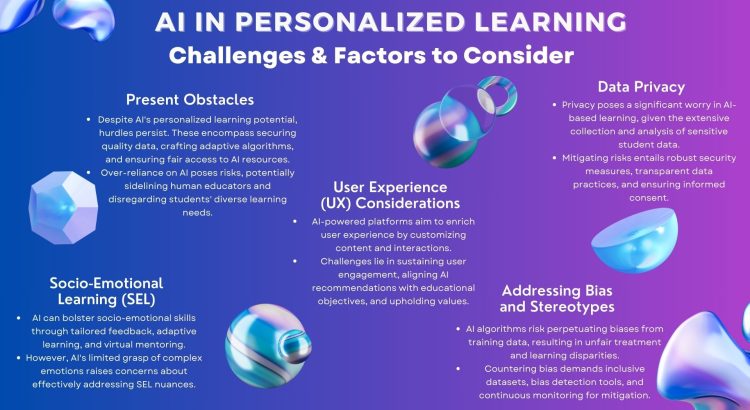
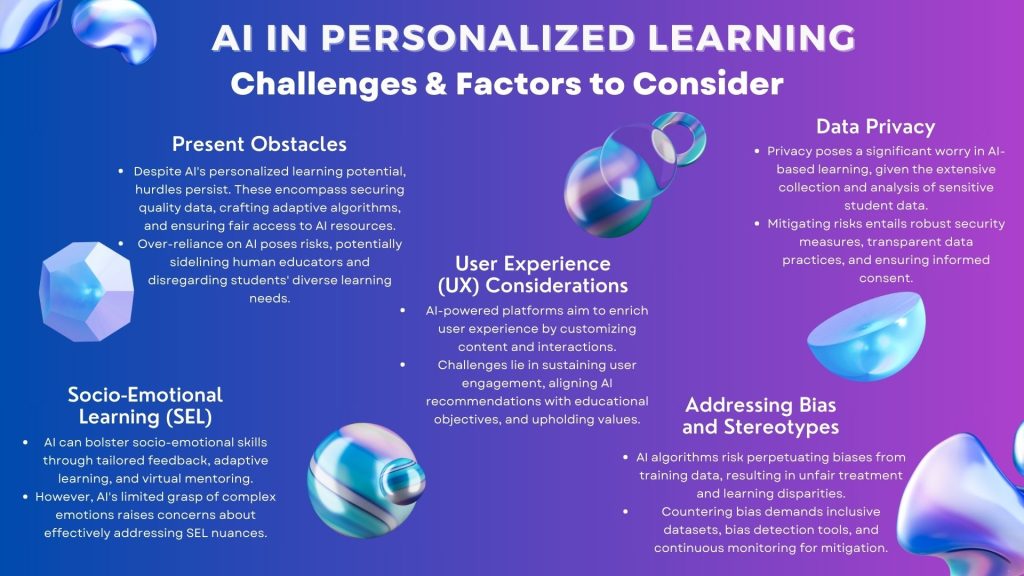
Infographic explaining different topic for AI in personalized learning

By Ano Gwesu, Asha Khan, Catherine Mcfee, Radhika Arora, Tracy Tang 

In the dynamic landscape of modern education, the integration of artificial intelligence (AI) has opened up exciting possibilities to revolutionize how students learn. Our journey into the realm of personalized learning has been one of exploration as we seek to understand how AI can tailor educational experiences to meet the diverse needs of learners. However, amidst the promises of enhanced learning outcomes, we have encountered significant challenges and ethical considerations that demand careful attention.

Exploring AI’s Educational Potential

At the core of our inquiry lies the intersection of AI and personalized learning, where algorithms analyze individual learners’ goals, strengths, and progress to deliver tailored content and feedback (Vetter et al., 2024). Through platforms like Udemy and Coursera, we have explored different courses, each offering unique insights into the application of AI in education. From practical guides for educators on leveraging AI in the classroom to innovative approaches utilizing AI technologies like ChatGPT, we have observed the transformative power of AI in shaping the future of learning.

Comparing Platforms: Understanding Education

Our investigation has led us to compare platforms such as Udemy and Coursera, each offering distinct advantages and learning experiences. Udemy’s emphasis on flexibility and accessibility allows learners to progress at their own pace, while Coursera’s structured approach offers academic rigour and accreditation options. We have gained valuable insights into the diverse online learning ecosystem by examining the course content, platform features, and instructor expertise.

Enhancing User Experience in AI-Personalized Learning

Our exploration underscored the critical role of precise prompts when utilizing platforms like ChatGPT for tailored learning experiences. This significance is further underscored in the course materials and West-Soley’s (2023) book, “AI for Language Learners,” which delves into techniques like capitalizing specific words to emphasize key concepts (West-Soley, 2023).

There are notable advantages to user experience. For instance, Duolingo boasts a free-to-use model, a user-friendly interface, and gamification elements that effectively motivate learners (Munday, 2015). Moreover, the platform offers accessibility and engagement for many users.

However, amidst these advantages, certain limitations also emerge. For instance, Duolingo’s personalization features are accessible only to paid members, and some learners report finding the lessons repetitive (Anderson & Charaf, 2020). Additionally, while ChatGPT offers the promise of tailored learning experiences, occasional errors have been observed, suggesting room for improvement in its implementation.

Challenges: Equity and Ethics

Nevertheless, as we delve deeper, we face pressing challenges that warrant our attention. The promise of AI-driven personalized learning must be tempered with a commitment to equity and inclusivity. We recognize that not all students have equal access to technology or the digital skills necessary to fully engage with AI-powered platforms (Warschauer & Matuchniak, 2010). Moreover, it must be acknowledged and understood by users of AI tools that large language models reflect all the racial and gender biases of the datasets on which they have been trained (Gordon, 2023). As we tread the path of AI-driven education, we must prioritize fairness, transparency, and accountability to ensure that technology is a force for good in education.

Empowering Teachers

Amidst the excitement surrounding AI in education, we must not lose sight of the indispensable role of educators. While AI can enhance learning experiences, it cannot replace the human connection and subtle understanding that teachers provide (Warschauer & Matuchniak, 2010). We advocate for a holistic approach that combines AI-driven tools’ strengths with educators’ expertise and empathy. By empowering teachers with AI technologies and fostering collaborative learning environments, we can ensure students receive personalized support and guidance tailored to their unique needs.

Balancing SEL and Privacy

In our exploration of AI in education also highlights its potential to enhance socio-emotional learning (SEL) by providing personalized feedback and insights (Vetter et al., 2024). However, we must tread carefully to ensure that these insights are leveraged ethically and responsibly. While AI can offer valuable feedback on emotional triggers and interpersonal skills, we must prioritize the privacy and autonomy of learners (Cavoukian & Jonas, 2012). By designing inclusive systems that uphold the dignity and agency of students, we can harness the transformative potential of AI to foster holistic growth and well-being.

Personalized Education with AI

We are excited about the endless possibilities ahead as we wrap up our exploration of personalized learning and AI. By addressing equity, privacy, and ethics issues with care and empathy, we can shape a future where education is accessible and uplifting for everyone. Let us seize this chance to leverage AI’s potential and ensure every learner can flourish. Moving forward, we will delve deeper into specific aspects of AI in personalized learning through our individual research endeavours.


References

Anderson, P., & Charaf, A. (2020). The reviews of users of the duolingo application: Usability and objectivity in the learning process. International Journal of Research – Granthaalayah. https://doi.org/10.29121/granthaalayah.v8.i9.2020.1326

Cavoukian, A., & Jonas, J. (2012). Privacy by Design in the Age of Big Data

https://jeffjonas.typepad.com/Privacy-by-Design-in-the-Era-of-Big-Data.pdf

Gordon, R. (2023, March 3). Large language models are biased. Can logic help save them? MIT 

News | Massachusetts Institute of Technology. https://news.mit.edu/2023/large-language-models-are-biased-can-logic-help-save-them-0303

Munday, P. (2015). The case for using duolingo as part of the language classroom experience. RIED. Revista Iberoamericana de Educación a Distancia, 19(1). https://doi.org/10.5944/ried.19.1.14581

Vetter, M. A., Lucia, B., Jiang, J., & Othman, M. (2024). Towards a framework for local 

interrogation of AI ethics: A case study on text generators, academic integrity, and composing with ChatGPT. Computers and Composition, 71, 102831–102831. https://doi.org/10.1016/j.compcom.2024.102831

Warschauer, M., & Matuchniak, T. (2010). New technology and digital worlds: Analyzing 

evidence of equity in access, use, and outcomes. Review of Research in Education, 34(1), 179–225. https://doi.org/10.3102/0091732×09349791

West-Soley, R. (2023). A.I. for language learners: Over fifty exciting prompt ideas for creating your own perfect learning assistant. Rich West-Soley, 2023.

First Team Blog-Ano, Asha, Catherine, Radhika, and Tracy,

We were asked to choose a learning technology and an event in this course. After discussing interesting topics, we decided on artificial intelligence (AI) with personalized learning. Upon researching online courses, we initially chose a course from the Udemy platform; as we began the course, we found that it needed to be more informative. We then chose a class on Coursera called Innovative Teaching Through ChatGPT; this class gave more examples of how to personalize education using ChatGPT. However, this class was only the beginning of our research. 

We each chose two articles or books to read to understand AI in personalized learning better. We found some similarities; for instance, both Selwyn (2019) and Magomadov (2020) discussed the importance of student-teacher relationships and how technology should not replace teachers but rather enhance their teaching and lessons. Each article discussed different benefits and challenges of using AI in personalized learning. 

One promising aspect Van der Vorst & Jelicic (2019) discussed was how AI can revolutionize learning experiences by tailoring them to individual students’ unique needs and preferences. They also explored the potential and challenges of implementing AI-driven personalized learning approaches. Akgun and Greenhow (2021) further emphasized the benefits, including using AI with automated assessment and predictive analytics. They believe that leveraging AI in these areas can significantly alleviate the administrative burden on teachers. Murtaza et al. (2022) also examined the change from conventional e-learning to a more personalized learning approach emphasizing tailored content and individual assessment. The articles underscored these advantages and acknowledged the need to address the associated challenges. 

We found various concerns in our research that had to do with ethics, privacy, and biases. For instance, Regan & Jesse (2019) pointed out that using AI raises questions about gathering data and how they are tracking and grouping students, which may be discriminatory. Further, the authors discussed that the interests of one group may overshadow those of different groups, specifically looking at vendors and educational technology programs. Yang et al. (2021) also mentioned the need for more governance as the lack of it, in combination with algorithm bias, could lead to further inequality. Al-Badi et al. (2022) looked into the perceptions that students and instructors had on using AI for personalized learning. The authors discovered mixed feelings as some found using these tools helpful to their learning. On the other hand, some were weary of using the technology as they expressed concern over privacy, trust, and the limited capabilities of using AI for personalized learning. These concerns and issues are all valid, and we will continue to address them throughout our research, looking at them in more detail. 

Building on our initial research, we are committed to further exploring the use of AI in personalized learning through a critical lens, considering ethical, political, and cultural perspectives. As we delve deeper, we invite you to join us in pondering the following questions that we believe are crucial to our understanding of this complex topic:  

  • How can AI-powered learning systems effectively engage individuals to obtain more precise data, facilitating the development of diverse learner personas that enable educators and researchers to gain deeper insights into individual attitudes and behaviours?
  • How can we ensure that the information given to students is credible and accurate when using AI for personalized learning? 
  • What is the role of instructors and learning designers in improving the quality of personalized learning recommendations? Who is responsible for governing how these vendors operate? 

Asha, Ano, Catherine, Radhika, and Tracy,


References 

Akgun, S., & Greenhow, C. (2021). Artificial intelligence in education: Addressing ethical challenges in K-12 settings. AI and Ethics, 2(3). https://www.ncbi.nlm.nih.gov/pmc/articles/PMC8455229/

Al-Badi, A., Khan, A., & Eid-Alotaibi. (2022). Perceptions of learners and instructors towards artificial intelligence in personalized learning. Procedia Computer Science, 201, 445–451. https://doi.org/10.1016/j.procs.2022.03.058

Magomadov, V. S. (2020). The application of artificial intelligence and big data analytics in personalized learning. Journal of Physics: Conference Series, 1691(1), 012169. https://doi.org/10.1088/1742-6596/1691/1/012169

Murtaza, M., Ahmed, Y., Shamsi, J. A., Sherwani, F., & Usman, M. (2022). AI-Based personalized e-learning systems: Issues, challenges, and solutions. IEEE Access, 10(1), 81323–81342. https://doi.org/10.1109/ACCESS.2022.3193938

Regan, P. M., & Jesse, J. (2018). Ethical challenges of edtech, big data and personalized learning: Twenty-first century student sorting and tracking. Ethics and Information Technology, 21(3), 167–179. https://doi.org/10.1007/s10676-018-9492-2

Selwyn, N. (2019). Should robots replace teachers? AI and the future of education. Polity Press.

van der Vorst, T., & Jelicic, N. (2019). Artificial intelligence in education: Can AI bring the full potential of personalized learning to education? Www.econstor.eu; Calgary: International Telecommunications Society (ITS). https://www.econstor.eu/handle/10419/205222

Yang, S. J. H., Ogata, H., Matsui, T., & Chen, N.-S. (2021). Human-centered artificial intelligence in education: Seeing the invisible through the visible. Computers and Education: Artificial Intelligence, 2, 100008. https://doi.org/10.1016/j.caeai.2021.100008

My Initial Thoughts on AI in Personalized Learning

In this course, we have been tasked with deciding on a topic to look at more critically. My group has decided to research artificial intelligence (AI) in personalized learning. In a previous post, I discussed the idea of more people using AI to learn English or another language, and that continues to interest me. A topic that has interested me throughout my research has been the credibility and accuracy of the use of AI in personal learning with a lens of language learning. To begin, I took part in a course on Udemy that originally appeared helpful in the team topic. Still, it became apparent that it could have been more informative regarding personalized education and using AI. Instead, we found a Coursera class called Innovative Teaching with ChatGPT.

 In this class, Professor Jules White discussed using ChatGPT to personalize lessons and topics to fit the students’ interests (J. White, personal communication, April 12, 2024). While he mentioned that this personalization could be done and that using ChatGPT could help teachers’ lesson plans, he also stressed the importance of reviewing what information you are given to correct errors before using it with students. He gave hints on how to write prompts into ChatGPT to get closer to the information I was seeking. It was great to begin researching the use of AI in the classroom. I also read the book Should Robots Replace Teachers? By Neil Selwyn (2019) to better understand the use of AI in education. 

Upon reading the book, Selwyn (2019), much like White, stressed the importance of recognizing that AI is not a perfect tool and that we must also be aware of who the programmers are behind the software. As Selwyn (2019) and Akgun & Greenhow (2021) stressed, we should examine educational technology through a political, cultural, social, and ethical lens. I will keep this in mind as I continue to research AI, personalized education, and its credibility and accuracy in being used with students. 


References 

Akgun, S., & Greenhow, C. (2021). Artificial intelligence in education: Addressing ethical challenges in K-12 settings. AI and Ethics, 2(3). https://www.ncbi.nlm.nih.gov/pmc/articles/PMC8455229/

Selwyn, N. (2019). Should robots replace teachers? AI and the future of education. Polity Press.

A Final Reflection on Leadership

Looking back on my first reflection on leadership, I do not think that too many of my thoughts had changed except for one: my role in project or change management. In my original reflection, I discussed some essential characteristics of a leader, such as caring, competence, and communication. Those are things I would look for in a leader. Being communicative is an essential characteristic for me, especially with recent shifts happening at my work. There are a few new employees and others taking on newer roles, and sometimes there is miscommunication. As Shenigner (2022) pointed out, communication is one of the essential pillars of digital leadership. The last few weeks have shown me the importance of keeping communication open between leaders and employees and among colleagues, which I am working on, and it brings me to reflect on my role in digital leadership. 

In another blog post, I discussed my thoughts on my work role. Initially, I reflected on my role as part of operations rather than on project management (Watt et al., 2014). Throughout the different assignments in this class, I have some characteristics that align with change management and digital leadership. For instance, I am adaptable and flexible when things change that are out of our control, which are traits of an adaptive leader (Khan, 2017). When completing our last assignment for this class, we had to think of a plan to incorporate a technology change. Upon researching and writing the plan for this assignment, I realized I have many ideas for incorporating technology into my organization for educators and children. For instance, when researching e-portfolios in early childhood settings, there were ideas on making portfolios more child-centred (Bedel et al., 2024), which I would like to incorporate. Thus, upon reflection, I have ideas that can benefit my work, and perhaps I have more leadership traits than I initially thought. I aim to continue discussing these ideas and incorporate them into my work one day. 


References 

Bedel, E. F., İnce, S., & Başalev Acar, S. (2024). Voices from the field: Integrating e-portfolios in early childhood education. Education and Information Technologies

https://doi.org/10.1007/s10639-024-12563-9

Khan, N. (2017). Adaptive or transactional leadership in current Higher Education: A brief comparison. The International Review of Research in Open and Distributed Learning, 18(3). https://doi.org/10.19173/irrodl.v18i3.3294

Sheninger, E. (2022, October 29). 7 pillars of Digital leadership. Houghton Mifflin Harcourt. https://www.hmhco.com/blog/pillars-of-digital-leadership-in-education

Watt, A. (2014). Project management. BCcampus Open Education Pressbooks. https://opentextbc.ca/projectmanagement/front-matter/introduction-2/

What’s My Role?: Project versus Operation

For this blog, we were asked to reflect on a recent project that we were involved in. Initially, I struggled with this as where I work, the educators are not entirely involved in the project management process but rather in the operation (Watt et al., 2014). When a change is being implemented, the ideas are brought by the daycare’s director to the educators and the board of directors. After an idea is approved, the change/project can begin. The person in charge of the project is usually the daycare’s director, and throughout the process, they inform the board of directors and educators on how the project is progressing. Thus, as I mentioned above, I am not part of managing a project but rather an operation. 

An example of a project the director headed was creating a website for the daycare. Initially, the daycare needed an online presence; it took much work for potential parents or employees to find information about the daycare. The director decided we needed a website for a better online presence. The creation of the website was the project, and the maintenance of the site and the backend was the operation, as it is ongoing and repetitive (Knolscape, 2013). The website aimed for parents to access important documents, like schedules, lunch menus and photos of special events. The goal for potential employees is to look at the website to gain information on our philosophy and mission. 

Once the website was created, it was up to the director to maintain it by continuously inputting the documents or photos. Because it is time-consuming to input these documents or images, I was appointed to be the person to do so. There were some barriers to the website as some parents were apprehensive about putting the children’s images online, making this barrier a cultural norm issue (Conway et al., 2017), as this website was new and parents were unsure of how it worked. Parents were given an account with a password to access these images to ensure this issue was resolved. Moreover, the parents are asked to sign a permission slip; if they still do not want their child on the site, we make sure not to use their photos. Implementing these accounts and permission slips made the parents feel more comfortable with the website. Another barrier is that I was initially the only one who could input these images or documents (causing a delay in updating if I was unable to input the new photos or documents), which would be a tame problem (Conway et al., 2017), as it had a simple linear solution: to train someone else to use the website. This specific barrier could have been avoided if more than one person had been trained at the outset. 

To conclude, while I was not part of the project management, I am involved in the operation and maintenance of this website. Some methods I would use in my practices would be to continue to have ideas for implementing more digital resources for both teachers and students. Before initiating these ideas, I would communicate them with the director, staff, and board of directors to understand organizational readiness and apprehensions before beginning the project.


References 

Conway, R., Masters, J., & Thorold, J. (2017). From design thinking to systems change. How to invest in innovation for social impact. RSA Action and Research Centre. https://www.thersa.org/globalassets/pdfs/reports/rsa_from-design-thinking-to-system-change-report.pdf

Knolskape. (2013, June 18). Introduction to project management. YouTube. https://www.youtube.com/watch?v=BOU1YP5NZVA 

Watt, A. (2014). Project management. BCcampus Open Education Pressbooks. https://opentextbc.ca/projectmanagement/front-matter/introduction-2/

External Scan

image showing the four key elements of change: plan, adapt, support, and change.

Image template source: @arfamojila on Canva

Reading about change management and the various models that could be used was mind-opening (Al-Haddad & Kotnour, 2015). Discussing change and change management with colleagues allowed me to narrow down four important key points for change. These four key points are planning, adapting, supporting, and educating. 

Recently, the daycare has gone through a significant change in that it expanded and doubled the amount of children in the centre. Both colleagues I discussed with mentioned the planning it took the leader to make this change go as smoothly as possible (C. Bentivegna, personal communication, February 9, 2024). Because the expansion was happening while the rest of the daycare was open, the director ensured the children already enrolled could still come as we could not shut down. Thus, ensuring the daycare remained open took much organization and planning. Regarding technological change, each class has recently been supplied with laptops. 

The provided laptops were to help educators plan activities, create a weekly schedule, and move towards creating the children’s portfolios using Microsoft Publisher instead of printing, glueing, and handwriting comments on paper. The provision of laptops also took much planning as the director needed to discuss the idea with the board of directors to get approval, and only then could the laptops and necessary software be provided. Of course, this was with some challenges, which brings up the idea that a leader must be adaptable. 

My colleagues and I discussed the need to make adaptations during these changes. While the director was organized and had planned for the change, there were some setbacks. Some setbacks involved were the delayed delivery of the materials, causing the two new daycare rooms to not open on time while the children were still coming to the daycare. Thus, the educators and director needed to adapt by briefly having the children enter a different class (C. Bentivegna, personal communication, February 9, 2024). Regarding the laptop, the educators needed to adapt to that change as they were not used to using the software implemented to create the children’s portfolios (A.B. Reis, personal communication, February 14, 2024). These two changes were extensive and required the director to plan and adapt accordingly. 

Both changes mentioned are on a large scale as they involve much planning, adapting, and vision (Al-Haddad & Kotnour, 2015). The board of directors was involved in both the expansion and the decision to provide the laptops, and the educators were asked for their input. While no formal change management method was mentioned, based on discussions and the strategies discussed by Al-Haddaded and Kotnour (2015), the organization seemed most similar to the Jick and Kanter method. This method has ten phases, and through the conversations I had with my colleagues, a few of them were brought up. The director analyzed the need for change, created a vision, developed a plan, communicated these ideas to the educators, and reinforced the change by providing necessary support. 

The implementation of laptops was where employees expressed their apprehension the most. As one of my colleagues mentioned, they were worried about using laptops as they are not the most tech-savvy (A.B. Reis, personal communication, February 14, 2024). On the other hand, my other colleague was relieved as it helped to make planning, finding activities and making portfolios more efficient (C. Bentivegna, personal communication, February 9, 2024). These differing opinions on this change are reminiscent of Weiner’s (2009) idea about change valence, as one colleague saw the value in the laptops right away compared to the other who was unsure about using them. Thus, the question was, what did the educators need to be at ease with using this new software? How can the director help with those needs? The director saw this apprehension and offered support by providing them with informational sessions on using the software. 

In order to support these educators, the strategy used was informational, where the educators were taught how to use the software through step-by-step workshops (Biech, 2007). If this session was not enough, she provided the educators with one-on-one sessions, which one colleague said was valuable to help increase their understanding of using the software (A.B. Reis, personal communication, February 14, 2024). The director still provides these informational sessions as new employees are onboarded throughout the year. These sessions are still valuable to employees, new and old, as the workshops are constantly evolving based on differing needs. Ultimately, the educators feel supported and more comfortable using the software. 

To conclude, these four key elements are what my colleagues felt were essential to making successful changes in the daycare. What was interesting about coming up with these elements was the experience they each had at the daycare, one colleague having over thirty years and another having six. While the amount of experience here differs, they both discussed the need for a leader to plan, adapt, support and educate. Thus, it shows that these four elements are valuable for a leader during a change. 


References 

Al-Haddad, S., & Kotnour, T. (2015). Integrating the organizational change literature: A model 

for successful change. Journal of Organizational Change Management, 28(2), 234–262. 

https://doi.org/10.1108/jocm-11-2013-0215

Biech, E. (2007). Chapter 3: Models of Change. In Thriving Through Change: A Leader’s 

Practical Guide to Change Mastery (pp. 21–33). essay, ASTD Press. 

Weiner, B. J. (2009). A theory of organizational readiness for change. Implementation Science4(1). https://doi.org/10.1186/1748-5908-4-67

A Reflection on Leadership

I have never been one to reflect on leadership; I have been in the same job with the same manager for approximately eight years and have yet to think about the different aspects a leader can bring to a team, nor have I thought about what kind of leader I could be. These last few exercises allowed me to reflect on what attributes, characteristics and values I would look for in someone in a leadership position. After completing the first activity, where I ranked different leadership attributes from 1-20 and then discussed them with my cohorts, I found my opinions on specific characteristics shifting in importance. 

After reading Workman and Clevland-Innes’ (2012) article on leadership versus management, a phrase that stood out to me in this reading was that “management affects outcomes for efforts, while leadership affects outcomes for people” (p. 319). I looked at this as managers trying to get favourable results from the workers, whereas a leader would try to see how they can help the team members reach their goals. Once I reflected on that and discussed it with my cohorts, my views on leadership characteristics somewhat changed, but not too drastically. For instance, one of my values when looking at leaders was that they were to be dependable, fair-minded, and cooperative, and while I still think that is true, they are no longer my top priority for leaders. I believe that what I would look for in a leader now would be that they are caring, communicative, and competent. Castelli (2016) discussed reflective leadership practices and the value of a leader being open to dialogue and feedback, which are attributes I would look for in a leader.  These attributes are essential when working in an early childhood setting where we must discuss the children’s abilities, interests and needs. As for leadership characteristics in a digital learning environment, I think leaders must be adaptable, as technology constantly changes.

 Khan (2017) discussed the concept of adaptive leadership in a higher education context. In the case of digital leadership, someone who is adaptable is vital as well. Adaptive leaders are flexible, recognize change, and find solutions that best fit their current challenges. As Shenigner (2022) pointed out in their definition of digital leadership, there is a lot of change, and schools constantly shift how technology is used to help students as new software and tools become available. Furthermore, in their seven pillars of digital leadership, Shenigner (2022) had communication in their first spot. In this context, communication would be a means to discuss with stakeholders in various ways, not just one way. For example, they could communicate through email and social media. Communication, whether in person or digitally, is essential for a leader. If they cannot communicate clearly, then issues could arise due to miscommunication.

Moreover, an adaptive leader could communicate differently depending on what others prefer (Khan, 2017). Another pillar that can connect to adaptive leadership would be to motivate students to be engaged (Shenigner, 2022). Both the pillar mentioned above and adaptive leaders find ways to encourage students to move beyond their capabilities and provide means to develop essential skills. Thus, the attributes I discussed, in the beginning, can also fit within digital and adaptive leadership, as I value a leader who can communicate and is caring and, after reading some articles, adaptable. 


References 

Castelli, P. A. (2016). Reflective Leadership Review: A framework for improving organisational performance. Journal of Management Development, 35(2), 217–236. https://doi.org/10.1108/jmd-08-2015-0112

Khan, N. (2017). Adaptive or transactional leadership in current Higher Education: A brief comparison. The International Review of Research in Open and Distributed Learning, 18(3). https://doi.org/10.19173/irrodl.v18i3.3294

Sheninger, E. (2022, October 29). 7 pillars of Digital leadership. Houghton Mifflin Harcourt. https://www.hmhco.com/blog/pillars-of-digital-leadership-in-education

Workman, T., & Cleveland-Innes, M. (2012). Leadership, personal transformation, and management. The International Review of Research in Open and Distributed Learning, 13(4), 313. https://doi.org/10.19173/irrodl.v13i4.1383 

Reflecting on My Design Principles

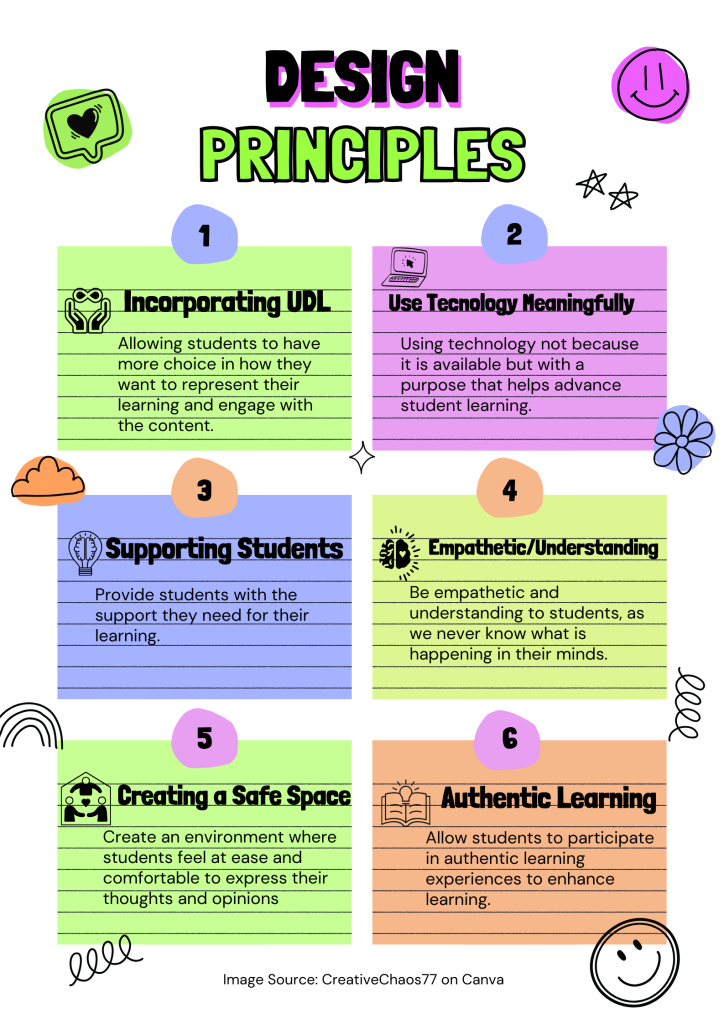
A poster showing the six design principles with short explanation text
To get a closer look at the image, use Catherine’s Design Principles

For this assignment, we were asked to think of some design principles that fit our context. The six design principles I have developed are linked to my current working context in an early childhood education setting but could also be used in future contexts, such as elementary school classrooms. Here are my six design principles. 

  1. Incorporating UDL: It is important to allow children and students to have the opportunity to show their understanding and learning in various ways. Not every student learns or shows their knowledge the same way; many diverse students are in the class. That is why I chose to incorporate UDL as one of my design principles because of their three principles of multiple means of engagement, representation, action and expression (Rao, 2021). These three principles give students more flexibility in their learning. 
  2. Use Technology Meaningfully: I mentioned in a previous blog post that I felt that technology in the classroom should have clear intentions behind it, and I still believe that is the case. Much potential for technology use in early childhood settings still needs to be explored in my context. Minds, O.O (2008) discussed various ways technology can be used in an early childhood setting, and some examples included using digital microscopes, tablets, and interactive whiteboards. While they gave examples of technology, they also emphasized that the “teacher’s intentional instructional planning” (Minds, O.O, 2008, p. 50) makes technology useful in children’s learning. Thus, while the technology is available, reflecting on why you want to use it is essential. 
  3. Supporting Students: Where I currently work, we are lucky enough to have behaviour and language specialists who come and work with the children who need extra help. To ensure that the children continue progressing, we communicate with these specialists and use their recommendations to help them in the classroom. 
  4. Being Empathetic and Understanding: When completing the design thinking process, the empathy phase was one of the more important ones. It made me reflect that these students are young; they could use more empathy and understanding as they may not be able to express their thoughts as eloquently as adults. When showing them empathy, the classroom environment tends to be more positive (Owen, 2015), and it is also equally important to teach them to be more empathetic to their classmates as it helps them build relationships with their peers. 
  5. Creating a Safe Space: Students spend the majority of their day at the daycare or in school; it is imperative that they feel comfortable and safe in this environment. Some ways to create a safe space would be to show students books with diverse characters, modelling proper ways to hold discussions and validate their feelings (Fierve, 2021). This principle can be connected to supporting students and being empathetic and understanding. If these principles are seen, the students could be more comfortable in the class and be more open to participating and contributing to the learning. 
  6. Authentic Learning: When the students participate in projects or assignments, it is beneficial to make it so their learning can be more authentic. What I mean when I say authentic is that they can relate it to their experiences and actively participate in their learning (Pappas, 2023). In my context, the students can be exposed to authentic learning through a large project once a year spanning from January to March, where they create posters/dioramas and present them to the class. For example, this year, the focus is on the ocean, so they will have to research their ocean animal, create a visual and present it to their class. Some other examples of projects are space, community workers, cultures worldwide, and more. Thus, they have been exposed to different themes and were able to bring their knowledge and experience to the projects.

References

Fievre, M. J. (2021, October 26). Cultivating the classroom as a safe space. Edutopia. 

https://www.edutopia.org/article/cultivating-classroom-safe-space/

Minds, O. O. (2008). Meaningful Technology IntegraƟon in Early Learning Environments. Young 

Children, 49. https://ecdc.cofc.edu/documents/naeyc-youngchildren-200809.pdf

Owen, L. (2015, November 11). Empathy in the classroom: Why should I care?. Edutopia. 

https://www.edutopia.org/blog/empathy-classroom-why-should-i-care-lauren-owen

Pappas, C. (2023, April 20). Authentic learning model: Creating meaningful learning experiences. eLearning Industry.

https://elearningindustry.com/authentic-learning-model-creating-meaningful-learning-experiencs

 Rao, K. (2021). Inclusive instructional design: applying UDL to online learning. Journal of 

Applied Instructional Design, (10)1, 1-9.

(PDF) Inclusive Instructional Design: Applying UDL to Online Learning 

(researchgate.net)

Augmented Reality: An Innovative Technology in Language Education?

For this blog, we were tasked with researching a learning innovation, and one that often appeared was the idea of augmented reality (AR) in education. While there are many definitions for AR, Maas and Hughes (2020) described it as virtual objects overlapping with objects in the real world and that they co-exist. While this article discussed AR in various subjects within education, there was a specific subject I wanted to explore as it interests me, and that is the idea of using AR in language education. Thus, this blog aims to look at AR in language learning. 

While augmented reality (AR) was not a technology that was readily available to all, with recent advances, there are many apps available on smartphones and computers that involve AR (Zhang et al., 2020). Augmented reality applications have become more popular, especially in science classes (Karacan & Akoğlu, 2021). A recent trend in education research is how AR can be used in language education. Karacan and Akoğlu (2021) mentioned that AR applications are not created with classroom use in mind; instead, it is up to the teacher to implement them effectively while keeping their learning objectives at the forefront. Some ways that teachers can use AR to help in language education are to implement AR flashcards and an application called Letters Alive, in which students can read vocabulary as they use 3D animations (Karacan & Akoğlu, 2021). Furthermore, there is an application called Metaverse where students can create their own stories, allowing them to practice writing and storytelling. While these applications help students learn English, the question remains: What kind of technology is needed for classrooms to support this software? 

Maas and Hughes (2020) discussed concerns about how some classes or schools may need access to computers or smart devices to implement this type of software. Similarly, Karacan and Akoğlu (2021) discussed having students bring their smartphones from home into the classroom, but that could be difficult as some students may not have their devices. Furthermore, it is not just access to these devices that schools need, but also to be aware of the storage the software will take up, whether they can maintain using it, and whether they have enough internet access. Therefore, while it is easy to say that the devices students need are more popular to have personally, that is not always the case. If schools want to implement AR software into language education, they need to be able to still provide students with the means to access it within the school and not require them to use it at home. Another aspect to reflect upon is if schools have access to similar applications mentioned above, what impact do they have on student learning? 

As mentioned above, AR applications cannot be used alone as a learning tool (Karacan & Akoğlu, 2021). Zhang et al. (2020) mentioned that AR mobile games specifically benefit student learning as they can move from just being in the classroom to providing students with the opportunity to collaborate and more context for their learning. When looking at AR specifically in language education, Karacan and Akoğlu (2021) agreed that mobile or game-based AR positively impacted student learning. For instance, the authors discussed that students were more motivated using an AR pop-up book. Furthermore, when students were using AR in their learning environment, they could experience more authentic learning, allowing them to participate in meaningful discussions. Some studies that Karacan & Akoğlu (2021) researched discussed that students were able to retain more content as the students were able to make connections “between theory and practice” (p. 71). Other studies mentioned that students showed better learning outcomes when AR was used in the classroom. For instance, when using AR to teach animal vocabulary to students learning English as a foreign language, they showed more progress than traditional means.

On the other hand, Frietas & Campos (2008), as cited in Karacan & Akoğlu (2021), mentioned that students with good academic success did not show any improvements, and students with lower academic success did. Finally, Zhang et al. (2020) also pointed out that AR does not consider learner differences. Thus, it might not be helpful to students who have learning difficulties, and teachers should remain the facilitator when implementing AR in their English language classrooms. 

To conclude, while AR is considered a technology with much potential to be implemented in the classroom, improvements still need to be made. For example, if the AR software cannot consider learner differences, the teacher should reflect on the application’s usability in their class to help students with learning differences. Furthermore, when considering using AR in the classrooms, schools should discuss how they feel about using it with teachers. Some teachers may think the AR software is overly complicated and are nervous to use it (Karacan & Akoğlu, 2021). Finally, there is some criticism of using AR in the language classroom as there is little theoretical support (Zhang et al., 2020). Thus, some main things to consider before implementing AR software into the class are to reflect on whether you have the technological capacities to use it, how it will impact students in the classroom, can teachers use it effectively in the class to help with language learning, and what kinds of theories support the use of AR.


References

Karacan, C. G., & Akoğlu, K. (2021). Educational augmented reality technology for language learning and teaching: A comprehensive review. Shanlax International Journal of Education, 9(2), 68-79. https://doi.org/10.34293/Education.v9i2.3715

Maas, M. J., & Hughes, J. M. (2020). Virtual, augmented and mixed reality in K–12 education:  A review of the literature. Technology, Pedagogy and Education, 29(2), 231–249. https://doi.org/10.1080/1475939x.2020.1737210

Zhang, D., Wang, M., & Wu, J. G. (2020). Design and implementation of augmented reality for english language education. Augmented Reality in Education, 217–234. https://doi.org/10.1007/978-3-030-42156-4_12 

Reflecting on Design Choices

Being in an early childhood and elementary setting, I have yet to be exposed to many Instructional Design (ID) models. I have more experience with teaching philosophies such as Reggio Emilia and Montessori, as these are the two approaches we use at work. Upon starting this course, I realised I have a slight knowledge of some IDs like Bloom’s Taxonomy (Heaster-Ekholm, 2020), where we discussed this model in my education psychology and child development classes during my bachelor’s. A more recent design I have been exposed to was the idea of Universal Design for Learning (UDL) (Takacs et al., 2021). 

In my final internship before graduating, one project was creating a lesson plan while keeping UDL in mind. In the specific class I was in, a couple of students already had Individual Education Plans (IEPs); thus, I was somewhat used to differentiating instruction, and I was up to creating a lesson while keeping all the students in mind. The idea of UDL is not to eliminate students’ IEPs or accommodations but to design a lesson that maximizes learning for most students (Takacs et al., 2021). I decided to do a reading comprehension activity with them, where using the Smart Board, I found a read-aloud on YouTube that incorporated the captions so they could both hear and read along. Afterwards, I asked questions about the book, and the students discussed their answers in a group. The students were engaged and enjoyed doing this activity, and it worked well to meet the needs of several students. I was lucky to have access to that technology. Using technology in the classroom was meaningful, as I did not want to use it just because it was there. 

Kale et al. (2020) discuss how teachers must understand how to integrate technology into their instructional design meaningfully. While it is great that schools now have access to different types of technology like Smartboard, laptops, tablets, and more, if it is not used meaningfully, it will not help students learn effectively. I was constantly encouraged to use technology during my internships when creating lesson plans. Thus, when coming up with my lessons, I reflected on ways to use technology, not just because it was there and I had access to it, but to help students understand the content and expand their knowledge. It was and still is important to me to reflect on the “why” I should use technology in this instance. 

In the end, using UDL and its three principles of multiple means of engagement, representation, and action and expression (Gronseth & Hutchins, 2019), I am constantly reflecting on ways to incorporate technology and how to create lessons to meet the needs of most students at once. 


References 

Gronseth, S. L., & Hutchins, H. M. (2019). Flexibility in formal workplace learning: Technology 

applications for engagement through the lens of Universal Design for Learning. TechTrends, 64(2), 211–

218. https://doi.org/10.1007/s11528-019-00455-6 

Heaster-Ekholm, K. L. (2020). Popular Instructional Design Models: Their Theoretical Roots and Cultural

Considerations. International Journal of Education and Development using Information and

Communication Technology, 16(3), 50-65.

Kale, U., Roy, A. & Yuan, J. To design or to integrate? Instructional design versus technology 

integration in developing learning interventions. Education Tech Research Dev 68, 2473–2504 (2020).

https://doi.org/10.1007/s11423-020-09771-8

Takacs, S., Zhang, J., Lee, H., Truong, L., & Smulders, D. (2021). Universal design for learning: A practical

guide. JIBC. https://pressbooks.bccampus.ca/jibcudl/