In my initial post about researching AI for personalized learning, I wanted to investigate the credibility and accuracy of using these tools for language learning. My idea was to use both Duolingo and ChatGPT to compare the information given to me when learning French. However, while I have a basic understanding of French, it would be difficult to test the credibility and accuracy of the information, so I decided to switch my topic to user experience instead.
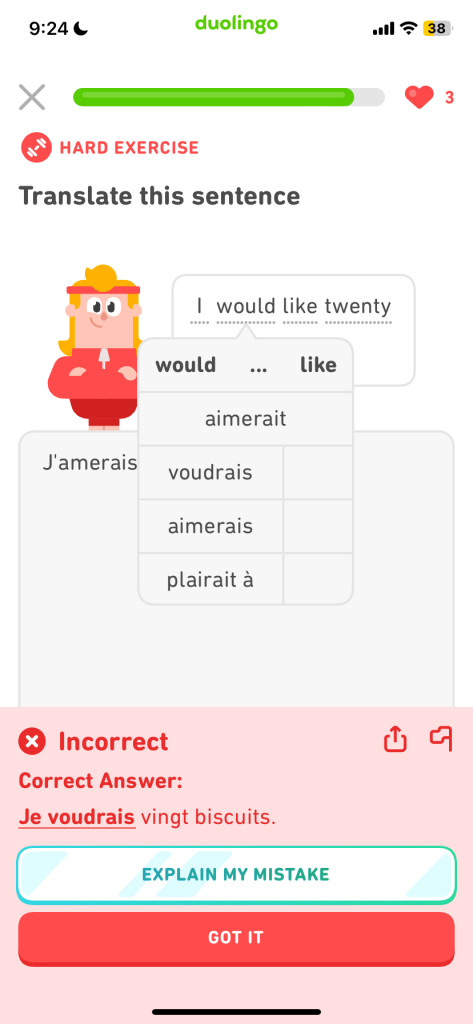
The mobile application Duolingo is not new to me; I have used it but have never taken the time to examine it as a user critically. As Anderson and Charaf (2020) pointed out, when looking at user reviews in the Google Play Store, many people discussed that paying a monthly subscription fee is the best use of the app. There are now two tiers of a paid subscription: Super Duolingo and Duolingo Max. While both tiers offer unlimited hearts and practice, DuolingoMax is where you can get a lot more personalized learning, as it will explain your answers or mistakes. You can roleplay (Duolingo Team, 2023). I currently only use the free version, and so far, there are things I enjoy, such as being easy to navigate (Munday, 2015); gamification is a motivator as it reminds me to keep practicing and gives me points. The downsides are limited lives, inability to practice mistakes, and inability to get explanations for my mistakes. To get the whole experience with Duolingo, near the end, I will use the free trial of Duolingo Max.
I have also been using ChatGPT to learn French. When using a tool like ChatGPT, it is essential to be mindful of wording your prompt (J.White, personal communication, April 12, 2024). My first time using the tool, I wanted a refresher on conjugating verbs to the proper tenses but in a more engaging way. After a few prompts, I decided to try a bingo game; ChatGPT would give me a conjugated verb, and I would have to write the tense in which it is. While the game was simple enough, I did catch some errors, such as inputting the wrong tense, but the program told me the answer was correct. While Huang and Li (2023) mentioned that using this tool can weaken people’s abilities to self-correct, I used it to double-check my answer with a verb conjugation website: https://leconjugueur.lefigaro.fr/. Thus, while using ChatGPT is not perfect, it allows me to check my work, and then I can correct the program by letting it know my answer was incorrect. A positive thing about using this tool is that I immediately get instant feedback and explanations, which I do not do with Duolingo.


As I continue to use these tools, I will also be critically aware of the potential for mistaken information and the program’s biases (Huang & Li, 2023). Further, I have yet to try using speech recognition with ChatGPT; there have been studies where students experienced tools like this needing help with speech recognition (Jeon, 2022), so this is something else I will explore. I have a question: How effective are AI-empowered applications in personalizing language learning?
References
Anderson, P., & Charaf, A. (2020). The reviews of users of the duolingo application: Usability and objectivity in the learning process. International Journal of Research – Granthaalayah. https://doi.org/10.29121/granthaalayah.v8.i9.2020.1326
Duolingo Team. (2023, March 14). Introducing duolingo max, a learning experience powered by GPT-4. Duolingo Blog. https://blog.duolingo.com/duolingo-max/
Huang, J., & Li, S. (2023). Opportunities and challenges in the application of chatgpt in foreign language teaching. International Journal of Education and Social Science Research, 06(04), 75–89. https://doi.org/10.37500/ijessr.2023.6406
Jeon, J. (2022). Exploring ai chatbot affordances in the efl classroom: Young learners’ experiences and perspectives. Computer Assisted Language Learning, 37(1-2), 1–26. https://doi.org/10.1080/09588221.2021.2021241
Munday, P. (2015). The case for using duolingo as part of the language classroom experience. RIED. Revista Iberoamericana de Educación a Distancia, 19(1). https://doi.org/10.5944/ried.19.1.14581
Hi Catherine,
Thank you for inspiring me to try out Duolingo. Your blog post was fantastic, as you highlighted learning French. I have family reasons for learning Spanish; therefore, I got started after reading about your learning experiences. I’m also testing ChatGPT while learning Spanish.
With ChatGPT, Huggard (2023) explained, “the model can generate responses to students’ questions, provide feedback on their work, and offer guidance on how to improve” (p. 46). At this point, I haven’t experienced any guidance on improving my Spanish. Two questions:
1) Did you receive specific guidance on how to improve your French from ChatGPT?
2) What are the prompts for finding the bingo game you referred to? I want to try it, but I have not located the game using the prompt “bingo game for language learning.”
In terms of speaking French, you may want to try Pimsleur for practice –
https://offers.pimsleur.com/ca-free-trial-1402-brand?msclkid=1d4792c57f4219babd1af48fd6057bf4&utm_source=bing&utm_medium=cpc&utm_campaign=SRCH_BNG_Sub_CA_Brand_General_General_None&utm_term=pimsleur%20language&utm_content=Brand_Languages_Phrase
On another note, I am curious about your opinion on the effectiveness of Duolingo’s characters. Do you prefer them when learning, or does the text-only user experience work for you?
Cheers,
~M
Reference
Huggard, G. (2023). ChatGPT for educators: Leveraging the power of AI in the education process.
Hi Marni, thank you so much for you comment and new platform to practice my French!
When working with ChatGPT for French or any language for that matter, I really focus on the prompts that I write to get the result I am looking for. Godwin-Jones (2024) explains the importance of prompt engineering and how to get desired results it is key to refer back to the previous input if you do not get what you’re looking for. For instance, when I was asking ChatGPT to create interactive games, it provided me with a list, and I chose the bingo game. When I saw it would only say if I was correct or not, I then asked for feedback which it then provided me with some in French (which I understood), but I would advise to specifically state for feedback in English if you’re not 100% certain on Spanish.
As for Duolingo, I enjoy the gamification of the application (Shortt et al., 2021) as well as the characters reminding me about my lessons and keeping my streak, so I tend to actually use Duolingo more than ChatGPT. Since using the free trial for Duolingo Max, I feel that the characters and lessons are more effective than they were previously and I get more feedback, but find that with ChatGPT it’s still more personalized as I am in control of what I am
learning.
I hope this answers your questions!
-Catherine
References
Godwin-Jones, R. (2024). Distributed agency in second language learning and teaching through generative ai. ArXiv (Cornell University). https://doi.org/10.48550/arxiv.2403.20216
Shortt, M., Tilak, S., Kuznetcova, I., Martens, B., & Akinkuolie, B. (2021). Gamification in mobile-assisted language learning: A systematic review of duolingo literature from public release of 2012 to early 2020. Computer Assisted Language Learning, 36(3), 1–38. https://doi.org/10.1080/09588221.2021.1933540
Interesting read, Catherine. Your experience resonates with my own background – I completed all my K-12 schooling at French language schools in Ontario. We were taught the formal rules of grammar and how to construct grammatically correct sentences, but often the way we actually spoke and communicated informally didn’t follow that structure.
I find it intriguing that you’re exploring the potential disconnect between tools like Duolingo, which seem geared more towards conversational verbal communication, and the formal way we’re taught to express ourselves in writing. The examples you provide of Duolingo not explaining mistakes and ChatGPT providing incorrect feedback highlight this gap.
Do you think there is an inherent tension between teaching the formal rules/grammar of a language and enabling more natural, conversational proficiency? How can language learning tools strike the right balance between these two objectives? Your examination of the user experience raises fascinating questions about personalization and different learner goals.
Hi Matt,
Thanks for your comment!
Since starting the Duolingo Max free trial, I have noticed that it is more helpful to get explanations on mistakes and gives me the grammar rules at the same time. Both tools are rather grammar and rule focused which I enjoy. Also with both Duolingo and ChatGPT I have been able to do a ‘roleplay’ aspect where we have a conversation around a theme. For example, with Duolingo I was prompted to have a conversation about books and what kinds of genre I enjoy. For ChatGPt, it is more my choice on the topic for practicing conversation as I have to prompt for one. You’re right that there can be tension for the either of the tools to strike a balance between both gramma and formal rules and mor natural conversation, but if I were to choose one for it to be easier to balance it out, it would be ChatGPT just because I am in more control of the conversation.
Cheers,
Catherine
Hi Catherine,
Thank you for breaking down the two tools so well – I will admit I had no idea ChatGPT could be used for language learning as well!
It seems that between the two, ChatGPT was the tool you found superior as you were provided feedback and explanation when there was a mistake, though it sounded like Duolingo was the more ‘fun of the two options with the gamification involved.
My question for you – do you feel that there was more of a focus on andragogy or pedagogy frameworks in either platform? Meaning, did it feel like the programs were geared towards young or adult learners, or is there a difference even required with this type of tool?
I ask because I have used Rosetta Stone in the past and chose it partially because I felt it was taking into consideration that as an adult learner I had different needs then a young learner, and allowed choice of how I received the lessons, etc.
Thanks!
Hi Jessica!
Thank you for your comment. Due to the gaming style of Duolingo (Godwin-Jones, 2024), I would say that it gears more towards younger learning or people just starting out to learn. With ChatGPT it requires a lot of prompting and re-prompting so it would be diffcult for a younger student do learn a language through that as they can have a difficult time figuring out how to phrase their prompt to get a result they are looking for.
I hope that answers your question!
-Catherine
Reference
Godwin-Jones, R. (2024). Distributed agency in second language learning and teaching through generative ai. ArXiv (Cornell University). https://doi.org/10.48550/arxiv.2403.20216
This is such an interesting exploration! Many users who operate outside of the framework of global Englishes find a lot of technological development frustrating because it is primarily for an English-language audience, so I wonder how these problems compare when English is not in the equation (eg. both learner and target language are operating in a language other than English).
Thanks Brenna!
You make a great point about what would happen if both the target language and language one is learning is not English. Throughout my research, I have attempted to find other languages discussed in terms of using AI tools for learning. For the most part, my research has been based in in Asia in which students are using AI chatbots to learn English as a Second Language (ESL) (Jeon, 2022). Although I have found some where they are learning Spanish or Turkish (Shortt et al, 2021). The lack of representation for other languages in the research could be something to look into further! In a perfect world perhaps one could build their own chatbot based on their own needs and languages as Godwin-Jones (2024) pointed out as more applications are narrowly targeted customization will become more popular.
References
Godwin-Jones, R. (2024). Distributed agency in second language learning and teaching through generative ai. ArXiv (Cornell University). https://doi.org/10.48550/arxiv.2403.20216
Jeon, J. (2022). Exploring ai chatbot affordances in the efl classroom: Young learners’ experiences and perspectives. Computer Assisted Language Learning, 37(1-2), 1–26. https://doi.org/10.1080/09588221.2021.2021241
Shortt, M., Tilak, S., Kuznetcova, I., Martens, B., & Akinkuolie, B. (2021). Gamification in mobile-assisted language learning: A systematic review of duolingo literature from public release of 2012 to early 2020. Computer Assisted Language Learning, 36(3), 1–38. https://doi.org/10.1080/09588221.2021.1933540