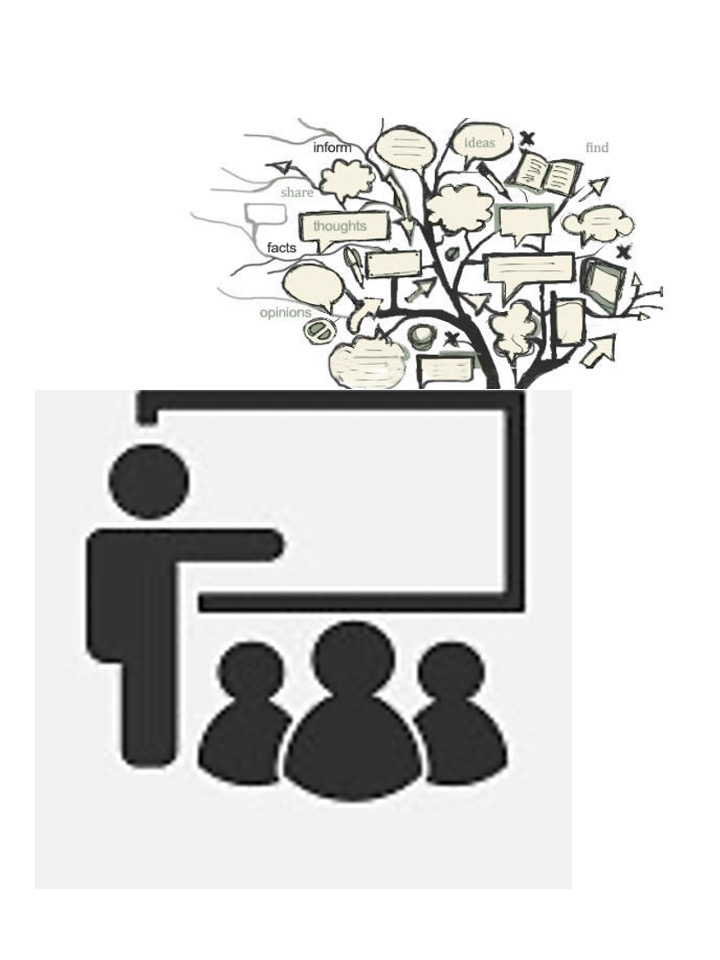
When asked to write this blog on our experience with instructional design (ID) tools and to create a graphic that represents our experience with them, I was lost in words, literally. I have limited instructional design experience because I have mostly facilitated other instructors’ training programs. However, Lachheb and Boling (2018) clarified my understanding of the different design tools (digital, theoretical, and analog) and the fluidity in which they can be applied.
Hence, I created my visual to represent an activation process to energize a group of learners who may be disengaged for various reasons such as unrelatable content (e.g., different industries, departments, or roles) or timing and/or length of the content delivery (e.g., after lunch, lengthy topic).
Generally, the courses I have facilitated were developed for large groups of learners across an organization. Even though, I have some flexibility to adjust some of the course sections, I regularly must respect the training flow to ensure the learning outcomes are consistent across learners in one organization.
Lachheb and Boling’s (2018) study clarified instructional design practice and tools, especially when they asserted that design tools and other tools are broadly and situationally applied, without a need for sequencing them like an ADDIE model. The authors further stated that “designers are placing these tools at their service rather than tools guide their design processes” (p. 47).
With this renewed inference, I can better share my design experience within my facilitation practice. I have used various design tools, mainly techniques (e.g., facilitation, negotiation) and approaches (e.g., constructivist-based activities) to activate the learners’ interest and motivation to gain knowledge. I recognize that as a facilitator, I am not always an expert on the topic I teach; however, I can certainly guide and interact with a group to build that knowledge (Ruey, 2010). I have used group work, discussions, and interactions to construct knowledge from the various learners’ perspectives. I have also used hands-on activities such as teach back, that is when learners become facilitators to revisit the knowledge acquired from a previous session. And finally, I have applied similar Veletsianos’ (2011) proposed transformative learning activities to engage learners through participatory and creative social-constructivist activities (e.g., group problem solving, simulations, though-provoking question), either in an online or blended training format. All the above design approaches to stimulate learning were often constructed in a few minutes while during my facilitation process.
In that sense, I was enlightened by Lachheb and Boling’s (2018) description of “design judgment” (p. 47) when the instructor is responding to the demands of a given situation. As a facilitator, I understand better my role as a potential conduit to engage learners through my new appreciation for instructional design tools, methods, and approaches.
References:
Lachheb, A., & Boling, E. (2018). Design tools in practice: instructional designers report which tools they use and why. Journal of Computing in Higher Education, 30(1), 34-54. https://link-springer-com.ezproxy.royalroads.ca/article/10.1007/s12528-017-9165-x
Ruey, S. (2010). A case study of constructivist instructional strategies for adult online learning. British Journal of Educational Technology, 41(5), 703-720. https://onlinelibrary-wiley-com.ezproxy.royalroads.ca/doi/epdf/10.1111/j.1467-8535.2009.00965.x
Veletsianos, G. (2011). Designing opportunities for transformation with emerging technologies. Published in Educational Technology, 51(2), 41-46. https://viurrspace.ca/bitstream/handle/10613/5056/designing-opportunities-transformation-emerging-technologies.pdf?sequence=1&isAllowed=y

December 7, 2021 at 4:08 pm
Hi Stephanie,
Thank you for your post. I really appreciated your focus on energizing and engaging learners in order to facilitate the most effective learning experience possible. I too found the idea of design judgement enlightening, and it made me realize how often teachers/designers/facilitators make snap judgements in the moment to respond to the needs of the situation. It certainly speaks to the need for flexibility, doesn’t it?
Thanks again,
Amber
December 21, 2021 at 8:19 am
Indeed it does Amber! I draw a parallel with this pandemic that everything can change in a day, and plans need to be adjusted to the new situation! Thanks Amber for your comment!
December 12, 2021 at 11:48 am
Stephanie, I was immediately struck by your use of the term ‘fluidity’ with regard to the application of design tools, and then slightly later, you referenced the ‘flow’ of training within an organization. I love the implicit movement, continuity, and unity in these terms, plus the potential to extend the metaphor. Rivers, streams, running water, and watersheds all come to mind. In my experience, online learning may become disjointed, particularly if a program evolves over time and is developed or renovated without careful design. I fully agree with your observations that instructors possess great latitude to creatively implement certain tools and apply “design judgement” (p. 47) as noted by Lachheb & Boling (2018).
Lachheb, A., & Boling, E. (2018). Design tools in practice: instructional designers report which tools they use and why. Journal of Computing in Higher Education, 30(1), 34-54. https://link-springer-com.ezproxy.royalroads.ca/article/10.1007/s12528-017-9165-x
December 21, 2021 at 8:17 am
Thanks Alisha for your comment. I love your analogy of rivers, streams for my fluidity comment. I agree that with online learning, the design flexibility may be more difficult; however, I had to change some of my prompts at time when I felt the online learners were not responsive, however, not some much the learning activity as per your experience.
December 27, 2021 at 2:59 pm
Thank you for sharing Stephanie.
I always find your perspective exciting and pertinent to the now. I think that learning and instructional design happen in many contexts and that very often we have to teach when we don’t always feel like an expert. I think this is a feeling we can all relate to. I agree that engagement is essential. Thank you for sharing.
Sam
January 3, 2022 at 9:50 am
Thank you for your comment Sam!