LRNT526 Research & Activities Log

Here is the log of events and research that took place during the course…

DATE

ACTIVITY

April 13  Complete Unit 1 Activity 1 – team, modality & presentation date selection

Team: May Bahador, Sean Doyle, Jason Keddie, Alfonso MacGregor & Klaus Rimke

Modality:  On line learning  Khan Academy  (*)

Instance:  Khan Academy  Intro to HTML & Intro to CSS  (*)

Link: www.khanacademy.org

Team’s name: “Khan Artists”

Presentation date: Sunday, May 13, changed to May 19, 2018

Begin participation in your team’s chosen modality and instance

COMMENT:  I was a late-arrival to the team, and they all welcomed me nicely.  I had no problem adopting the modality that was already chosen.

(*)  These concepts were clarified with the instructor one month later, a week prior to our team’s presentation date.

April 14 Team members exchanged information and opinions via Google Docs.

COMMENT:  Through the MALAT programme, Google Docs has proven to be of high value to collaborate simultaneously as well as asynchronously.

April 15 Team description of modality chosen submitted.

COMMENT:  The modality of Khan Academy was clearly understood by all the team members.  The instance was not clear as such although we agreed to take a couple of courses to familiarize ourselves with Khan Academy.  We did not think the agreement as the instance until the instructor told us that was it.

April 15 Initial summary of modality & approach to critical inquiry submitted.

COMMENT:  The team collaborated to put together the summary, and it was posted in Klaus Rimke’s blog.  Khan Artists received useful feedback from the instructor which was incorporated in subsequent pieces of work.

April 16 Began work on Assignment 1 Part 1     
April 19 Began work on Assignment 1 Part 2
April 20 Complete Unit 1 Activity 3 – individual blog post

COMMENT:  When I posted this work I was still considering the modality and the instance wrongly.  I was also regarding Khan Academy material an OER, which later was rectified to refer to it as Online Educational Video.

April 29 Submitted Assignment 1 Part 1 | Individual Learning Plan
May 6 Submitted an outline for Assignment 1 Part 4 | Critical Reflective Paper

COMMENT:  The outline mentioned the opportunity that having construction sites in several campuses of a school district represented for applying the students’ learning.  Some clarification was done via e-mail with the instructor, and he approved the idea of localisation as a good proposal to develop.

May 11 Attended DEE GEEs Presentation @ 7:30 PM / PST

COMMENT:  One, if not the most, important contribution the DEE GEEs did to the class was being the first team to present.  Their experience shed some light on the “mystery” of what the instructor was expecting from the class.

May 12 Provided feedback to the DEE GEEs team
May 14 Attended MOOCtastic Presentation @ 7:00 PM / PST

COMMENT:  The MOOCs immersion we had with the MOOCtastic team was extraordinary.  They did an excellent job researching and reporting the outstanding features of the MOOCs.

May 15 Provided feedback to the MOOCtastic team
May 15 Attended TEDdy BEARS Presentation @ 7:30 PM / PST

COMMENT:  The TEDdy BEARS presentation revealed interesting aspects regarding not only the cost, or absence of it, of some educational resources but also the “certify-ability” of them.

May 16 Provided feedback to the TEDdy BEARS team
May 18 Attended AWESOME SAUCE Presentation @ 7:00 PM / PST

COMMENT:  This team’s session included a nice dose of sense of humour which made the presentation extremely enjoyable, without diminishing the interesting information they presented.  The Awesome Sauce team made a clever use of their name playing with words and ideas to convey their content.

May 19 Provided feedback to the AWESOME SAUCE team
May 19 KHAN ARTISTS Presentation @ 7:00 PM / PST

COMMENT:  Being the last team to present represented also a challenge since the audience was already “trained” on what to expect.  There was enough difference in our modality and content in relation to the other presentations that the audience welcomed the novelties with interesting questions and positive feedback.

May 21 Received feedback for the KHAN ARTISTS team
May 22 Submitted summary of reflections and comments on feedback received


LRNT526 U3 a1 – Last Minute Change and Summary

Last Minute Change

While working on Assignment 1 Part 2, I thought I had my presentation well under way since I had exchanged comments back and forth with the instructor, and we both coincided in that Localisation was a good and interesting approach.  It was indeed outlined in the preliminary work of Assignment 1 Part 4, required as a draft for which I received useful feedback.  The term Localisation usually refers to accommodating content to cultural and/or national boundaries (Amiel, Squires, & Orey, 2009, p. 29).  My presentation used Localisation to incorporate local elements that reinforced the learning from the Khan Academy’s videos selected as the instance for the assignment.

Assignment 1, part 2: Khan Artists presentation. Selected modality: Khan Academy. Chosen instance: Intro to HTML & Intro to CSS (Bahador et al., 2018).

And speaking of instance, during our team sessions, a doubt appeared concerning what the terms instance, issue, and aspect mentioned in the directions meant.  We could take the usual meaning of those words but they seemed to be used interchangeably, which caused some confusion to the team.  We needed to be on the safe side because our team’s video was still to be produced and the clock was ticking.

The instructor’s clarification came as a much needed directive:  All team members must work on one and the same instance.  This did not affect my colleagues’ work but, in my case, I was doing the Localisation of a supplementary Geometry resource to the Khan Academy online educational videos, so I had to shift the focus to the instance of the Introductory courses to HTML (Hyper Text Markup Language) and CSS (Cascading Style Sheets) (Khan Academy, 2018).  In the end it worked out fine, although the extra time the change required could have been used to do some final fine-tuning.

Summary

The teams’ selections provided a diverse set of presentations allowing the audience to gain some insights to a variety of modalities.  Among these were the Massive Open Online Curses (MOOCs) which, honoring their name, are widely dispersed throughout 196 countries and across multiple networks.  Their content offerings cover a vast range of topics, and being open and online have helped them gain popularity among both universities and individual learners alike (Adamopoulos, 2013).  Coursera and edX belong in this category, and their specific weight in the trend comes from large universities and organisations including them in their staff development options (Daniel, 2012; Noer, 2012).

Another modality was the curated video library represented by Lynda.com.  This case’s story precisely depicts what being in the right place at the right time is, besides posessing the knowledge people needs to learn at hand.  Having started with the topic of how to develop a web site, triggered by the absence of accessible resources in the market, Lynda.com then grew not only adding topics but also going through uncertainty, both financially and technologically speaking (Porter, 2015).

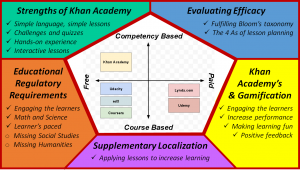
To summarise the sampling, the infographic Khan Artists prepared illustrates how the modalities selected by the teams fit in the grid comparing competency versus course based, and paid versus free options.

Assignment 1, part 2: Infographic of Khan Artists presentation (Bahador et al., 2018).

It is interesting to see that Khan Academy’s online educational videos contrast with the rest by being competency oriented, which corresponds completely to the origin of these tutorials: Sal Khan aimed to help his niece to become competent on specific topics (Bhatt et al., 2014).

Conclusion

The vastness of resources available in the education field is impressive.  One of the best approaches an educator may take is to be open considering as many resources as feasible to give the students access to learning.  Such variety of options might as well help solve the need of differentiated instruction, which at times can be challenging for the teacher.

References

Adamopoulos, P. (2013). What makes a great MOOC? An interdisciplinary analysis of student retention in online courses.Retrieved April 12, 2018 from http://pages.stern.nyu.edu/~padamopo/What%20makes%20a%20great%20MOOC.pdf

Amiel, T., Squires, J., & Orey, M. (2009). Four strategies for designing instruction for diverse cultures: Context and localization of learning objects. Educational Technology 49(6). 28-34. Retrieved from http://www.jstor.org/stable/44429738

Bahador, M., Doyle, S., Keddie, J., MacGregor, A., & Rimke, K. (2018, May). Khan artists. Presentation prepared in fulfilment of the part 2 of assignment 1 of the LRNT526 course, MALAT programme of Royal Roads University, Victoria, CA.

Bhatt, Grozdev, Hackney, Love-Davis, Stankiewicz, & Walters. (2014). Student case study: Khan Academy. Retrieved from http://fletcher.tufts.edu/~/media/Fletcher/MIB/pdfs/B236%20Student%20Case%20Studies/Khan%20Academy%202014.pdf

Daniel, J. (2012). Making sense of MOOCs: Musings in a maze of myth, paradox and possibility. The Journal of Interactive Media in Education. Retrieved from https://www-jime.open.ac.uk/articles/10.5334/2012-18/

Khan Academy. (2018). Retrieved from https://www.khanacademy.org/

Noer, M. (2012). One man, one computer, 10 million students: How Khan Academy is reinventing education. Forbes. 1-8. Retrieved from http://www.prisim.com/wp-content/uploads/2013/12/One-Man-One-Computer-10-Million
-Students-How-Khan-Academy-Is-Reinventing-Education-Forbes.pdf

Porter, J. (2015). From near failure to a $1.5 billion sale: The epic story of Lynda.com. Fast Company.  Retrieved May 30, 2018, from https://www.fastcompany.com/3045404/from-near-failure-to-a-15-billion-sale-the-epic-story-of-lyndacom

LRNT526 U2 a1 – Critical Reflection on Localization, part II

A Different Kind of Localization

As mentioned in part I, the domestic elements in this particular case are not of the typical nature related to the language nor the cultural framework.  The basic elements -because there are several kinds involved- are circumstancial and they might represent a unique opportunity to reinforce the learning process.

The Basic Elements

The basic elements originate from an important bond  approved for the school district, which enable them to proceed with major construction projects at six of their thirteen campuses.  Construction sites serve as the basis to generate interest and curiosity in any community.  Being these sites in campus the students would have their thought-provoking wells right there, which teachers shall translate into novel paths for learning.

The Second Element in Line

So the foundations for the localization effort are the schools’ construction sites.  The second element required comes in the form of the curriculum-related aspects the teachers would guide their students to focus on in order to work on the third and fourth elements.  These could include writing,  science, mathematics, or social studies aspects that the students shall be able to investigate with regard to the new facilities being built or renovated.

Elements Three and Four

Using the curated video library of Khan Academy provides the third and fourth elements which would be dealt with side by side.  The reason for this being that the third element consists of the Khan Academy courses Introduction to HTML and Introduction to CSS, while the fourth element is what the students learn completing exercises and challenges while watching the videos.

The Fifth Element

Finally, the localization effort would represent the fifth element, and it would require the teachers’ creativity to ask their students their ultimate challenge: To use the knowledge  acquired on HTML and CSS to include content in the web pages they created, that would cover specific aspects of the construction projects like the physical dimensions of the new auditorium, the functionality of the new gym, the appearance of the new classrooms or labs, and so forth.

Added Benefit

The school district would have the option to include in their official web pages at both district’s and schools’ levels the work produced by the students.  This could be managed in various ways ranging from district-wide schools contests to school-based committees doing the selection.  Either approach would benefit all by giving exposure and recognizing the students’ learning and achievement.

Final Observation

The localization effort described above aims to capitalize on special circumstances present at the time.  The effort could be applied in a setting that does not involve a construction site.  If any other special circumstance is in effect, it can be considered as it better serves the goal.  Otherwise, it can be used under the regular operating conditions of any school district or campus.

LRNT526 U2 a1 – Critical Reflection on Localization, part I

The First Impression

Signing up for the Khan Academy (KA) was exciting since it was the first time I was going to try it.  The preconceived ideas of what I would find in their sessions were in my mind like templates waiting to be filled up.  The reason for this was the simplicity I have read was one of the main characteristics of KA’s material.

Once the registration steps were done I was ready to start, and I was not disappointed because what I was presented with was indeed simple.  Additionally, I was surprised by the way the video motivated me to do my part.  It did not appear as a template but rather it actually flowed like an interactive session, furthermore the prompts shown when the learner made a mistake encouraged the student to understand the concept, try again, and get it right.

Potential for Localization

Openness in educational resources has made their access easier for many people and institutions which happen to find the contents in a popular language or culture that, in some cases, may not be the best fit for their learning goals.  Localization provides the contents with domestic elements or features needed, without altering the core, in order to be effective (Amiel, Squires, & Orey, 2009, p. 28).

Is it possible to increase the effectiveness of a resource with easy-to-learn content?  The simplicity achieved in each KA session, which is the result of breaking down a topic in smaller pieces of instruction, make it also suitable for localization as will be explained in the next blog.

References

Amiel, T., Squires, J., & Orey, M. (2009). Four strategies for designing instruction for diverse cultures: Context and localization of learning objects. Educational Technology, 49(6). 28-34. Retrieved from http://www.jstor.org/stable/44429738

LRNT526 – U1 a3 – Academic Reflection

LRNT526 U1 a3 – Academic Reflection on Khan Academy and a Specific Issue Exploration

Our team, Khan Artists, selected the Khan Academy as the Open Education Resource (OER) to experience and work with on this course.  Individually, I will explore the possible effects and consequences of adding a local complement to what a specific Khan Academy resource offers to the students from the standpoint of their regular curriculum.

Kami Thordarson thought Khan Academy’s to be a helpful resource to supplement her fifth grade instruction at an elementary school in California, US (Thompson, 2011, p. 2).  Khan Academy is a non-profit organization that actually offers short lectures in the form of YouTube videos available to the public through the Internet (Kaplan, 2010).

The outcomes that Thordarson reports after a few months of introducing Khan Academy to her classroom are impressive.  The results refer to students’ self-motivation on the one hand, and with increased individual performance on the other.  These aspects are perfectly aligned with the self-determination theory (SDT) which, as stated by Deci and Ryan (as cited by Chen & Jang, 2010, p. 742) explains from the standpoint of a general theory of motivation the dynamics of the human needs, motivation, and well-being with regard to the social context surrounding the individual.  SDT, as coined by Deci and Ryan (as cited by Chen & Jang, 2010, p. 742), implies the experience of choice as a core piece of human functioning.

Furthermore, SDT as a theoretical framework puts together elements of online learning such as autonomy, relatedness, and competency as determinants of motivation (Chen & Jang, 2010).  And last but not least, three elements correspond to fundamental aspects of online learning: flexibility for learning; computer-mediated communication and social interaction; and the challenge of developing or acquiring technical skills along with the content being taught (Chen & Jang, 2010).

As part of our team warm-up activity, each member signed-up in Khan Academy and took the first two introductory courses on how to program a web page.  The experience allowed us to confirm the simplicity and friendliness of how the content is presented, as well as the elements that keep the student hooked on using the resource.

The specific aspect that I chose to explore refers to the localization of a resource that would be complementary to the Khan Academy.  Without pretending to compete with Khan, the addition of the local resource aims to increase the student’s sense of ownership due to familiar elements that would be incorporated with the local resource.

It will be interesting to learn the effects local elements would create on the students, and if those elements actually favor the learning in the audience.  The setting would be as follows.  After completing a Khan video the student would see the corresponding local video that will cover the same content, and this time several features of the local environment in which the student lives shall be included in the lesson as well as one of the local teachers conducting the session.

Thank you for taking the time to read my work.  I will appreciate the feedback I receive from instructor and peers, since it will contribute to my further researching the topic and learning deeper with this assignment.

References

Chen, K. C., & Jang, S. J. (2010). Motivation in online learning: Testing a model of self-determination theory.  Computers in Human Behavior 26. 741–752. Retrieved from https://s3.amazonaws.com/academia.edu.documents/32717732/Chen_Jang_CHB_%282010%29.pdf?AWSAccessKeyId=AKIAIWOWYYGZ2Y53UL3A&Expires=1524290148&Signature=5bvLt2pL2XXwe%2Fl6d8%2F2txOxTko%3D&response-content-disposition=inline%3B%20filename%3DChen_K._C._and_Jang_S._-J._2010_._Motiva.pdf

Kaplan, D. A., (2010, August). Innovation in education: Bill Gates’ favorite teacher. Fortune. Retrieved from https://web.archive.org/web/20101223035558/
http://money.cnn.com/2010/08/23/technology/sal_khan_academy.fortune/

Thompson, C., (2011, July). How Khan Academy is changing the rules of education. Wired Digital. Retrieved from https://s3.amazonaws.com/academia.edu.documents
/40764790/Khan_Academy
_technology.pdf?AWSAccessKeyId=AKIAIWOWYY
GZ2Y53UL3A&Expires=1524258037&Signature=6nHI8vA7MOFFH49qhUZMPjrdbpw%3D&response-content-disposition=inline%3B%20filename%3DKhan_Academy
_technology.pdf

LRNT525 U5 a1 – Final Reflection

Final Reflection

As the end of the course gets closer I become aware of its richness.  What has been covered with the readings, collaborative sessions, activities, assignments and, most of all, teamworking have made LRNT525 one of the most comprehensive pieces of the MALAT program so far, and maybe the best part of my assertion is that I have heard it from my peers… and I agree.

Reading my first post I noticed that a few weeks ago I thought differently about change in general.  With regard to education, and specifically involving digital learning, there are times when it is necessary to cause change regardless of the interruption of continuity that comes with it.  As I stated in the last assignment, the awareness of the disruptive nature of change often makes me refrain from causing it, although through the fourth assignment it became clear that at times it is the right path to follow.

Several aspects are of relevance so that we know we are planning a project that involves some changing, and it has to be in the right direction.  Involving the adequate people is of utmost importance because simply stated if there is no people, there is no project.  Somebody would have to provide the resources to carry the project forward.  Somebody would have to be interested in the project to take place.  Somebody would have to be involved in performing the activities and tasks that conform the project. And, finally, somebody would be using the outcomes of the project once it is implemented.  That is why without stakeholders there cannot be a project.

It is interesting to note that in my final assignment the project for a change related with learning technology would bring in an additional piece of technology, and the complex system it would have to become in good terms with in order to succeed is the bureaucracy of the public school system, not another technology platform or environment.  Which stresses the importance of identifying the stakeholders and involve them on time in the project.

I am planning on following a research path closely related to the topic I developed for the last assignment of LRNT525, and it was so motivating to think forward on what the project might bring me in contact with, very exciting!

On a last note I would like to thank my instructors and peers for their patience and collaboration.  Studying remotely is proving to be both challenging and fulfilling.

Thank you all, we will keep on working along our journey!

Alfonso

LRNT 525 U3 a2 – Environmental Scan

While at Sam Houston Elementary in Port Arthur, I. S. D., located in Port Arthur, TX., where I taught Kindergarten and Pre-K, I volunteered to make a SWOT analysis and, although the study did not focused on teaching nor learning activities, the focal point of the SWOT study has a direct impact on the educators’ main responsibility: teach.

The school district requires all schools –ranging from early childhood to 12th grade– to create and maintain files of all their students.  The files are referred to as “permanent folders”, and that is what they actually are: paper folders containing paper sheets.  The sheets contain forms and formats in which data of specific processes have been registered, and the sheets have to be placed in the folder following this sequence:

  1. Birth certificate, social security card, proof of address (stapled inside of the folder’s front cover).
  2. Permanent record card.
  3. Final report card (updated at the end of the school year).
  4. Current school year test scores (TAKS, STARS, iStation, Chicago Early-PK).
  5. Current school year parent conferences (beginning and end of year).
  6. Current school year promotion/retention information (filed at the end of the school year).
  7. Important notes and communications (as required) (*).
  8. All previous school years information to be kept in this section, starting with most recent.
  9. Home language survey form (if applicable, filed before the school starts, stapled inside of the folder’s back cover).

Several school members are involved in compiling information througout the school year.  The numbers of this list serve to match individuals with documents of the previous list:

  1. Attendance clerk receives documents from parent/guardian.
  2. Teacher of title.
  3. Teacher of title.
  4. Teacher of title.
  5. Teacher of title.
  6. Teacher of title.
  7. Attendance clerk, teacher of title, or administration staff as required.
  8. Current teacher of title must verify all documents are in sequence and complete.
  9. Admission/multilingual clerk (if applicable).

With regard to resources all is managed on paper, and the forms are manually filled out by the required person.  It is important to take into account that the filing cabinets are within the attendance office, and their custody is responsibility of the attendance clerk.  So a log is kept for the permanent folders to be available for consult or update only during the office hours of the attendance office –7:00 a.m. to 4:00 p.m.–, and all files checked out during the school day must be returned before attendance closes for the day.

Since the processes of compiling the information to fill out formats were all manual, there was no digital technology involved.  Although the school district policies clearly stated the mandatory nature of keeping complete and flawless records of every student, every year at convocation, the superintendent emphasized that this matter was subject to a random compulsory audit process.  His style of leadership was obviously power, due to the hierarchy of the post as head of the school district (O’Toole, 2017, p. 4).

In the end, the school’s principal must make sure all faculty and staff complied with the permanent folders’ procedures.  The leadership style varied according to the principal of each school, and the effectiveness would differ greatly depending on the approach the principal took toward the permanent folders process.

There were several due dates during the school year to make sure the permanent folders were kept up to date.  As those dates approached the need of the teachers to work with the folders increased, and the tight schedule of folders’ availability made the teachers find time during the day to get some progress with the folders’ duty.  The most demanding process was the year-end massive update.  To the extent that some teachers gave the students assignments to work with in the classroom while the teachers tended to the folders.

Even though faculty is not supposed to do this, it was a common practice that is easier to do the higher the grade level. On personal experience I can state that Pre-K and Kinder students do not engage long enough to allow the teacher to work on the folders, since their constant interaction with the educator might increase the chance of error.  Some colleagues even resorted to have the children watching movies, but I considered it an inappropriate practice.

Instead, I requested the assistant principal for an extended schedule that allowed me access to the folders, and she agreed to let me enter the attendance office while she was in the school.  I got the extra time I needed without cutting my instruction short.  Her servant leadership style was absolutely helpful (O’Toole, 2017, p. 4).

The SWOT analysis is summarized as follows:

STRENGTHS > Faculty was highly commited to comply with the requirements established for the permanent folders.  Even if this resulted from the convocation reminder, it still represented a strength.

WEAKNESSES > The reduced availability of access to the folders forced faculty to diminish instruction time in order to be able to complete all the folders-related administrative work, thus affecting the amount and quality of their teaching.

OPPORTUNITIES > Having an information system would greatly benefit the schools and the district.  The information shall reside in a central repository, allowing online access without a restrictive schedule.  The information system shall have appropriate security management in place, with access provided in accordance to a privilege structure of user and password.  Additionally, back-up procedures would be in place to comply with audit processes, as well as to ensure prompt recovery of information in a crisis scenario.

THREATS > The current situation has the schools and district exposed to data loss due to unplanned events ranging from spilling coffee over one folder’s documents to floods and fires.

Undoubtedly there would be costs involved although they were not identified nor calculated at the time, and they would refer to both options: continue with the current practices and procedures, or implement the recommended measures of improvement.

Not implementing the change would mean keep affecting the learning of the students by eroding the teaching quality of the educators due to the time and effort required by the administrative duties described in the case.  Additionally, the cost of re-building the paper folders again –to the extent of what would be possible– should a crisis occur must also be considered.  While implementing a change would require budget to buy or develop the information system with the functionality broadly described above, the technology platform was already in place so the cost would refer almost solely to the software, its implementation, and the training of personnel.

The learning opportunities would be for all the schools’ faculty and staff, and the district’s personnel in learning how to use the information system that would help them fulfill the administrative duties of the permanent folders –they may no longer exist as such– in a much more efficient way to become digital permanent folders.  There would be other benefits derived from having such information system, among which are the information available and better use of faculty’s time.  And last but not least, the students would also benefit from having more time of their educators devoted to prepare class and teach.

__________________________________

(*)  To further document the time shortage certain situations caused the teacher, consider the case of a student who the educator detected as candidate for special support.  It is the teacher of title’s responsibility to open a file and follow the procedure, coordinate and attend meetings with parents and specialists, and do the paperwork to document the case for the school and district to evaluate.  The process can take more than a school year to complete thus the student’s special needs might stay unattended for quite a long period of time, which affects not only the student’s performance taking up teacher’s time, but might also impact the quality of the classroom climate.

References

All graphic material retrieved from the creative commons website https://search.creativecommons.org/

O’Toole, J., (2008). Notes toward a definition of values-based leadership. The Journal of Values-Based Leadership1(1).

LRNT525 U3 a1 – Project Management

In every organisation each department is expected to complete their duties and do it well.  Nobody likes the idea of having someone else stepping in to check their work.  The audit department (or firm) is generally seen as an unwelcomed entity, and being regarded so makes everyone’s job less comfortable.

Why does audit exist?  Regardless of the size and type of organisation, there is the need for an independent check and balances reporting, mostly on the financial aspects of the business (Braiotta, Colton, & Ramamoorti, 2010), although some corporations extend the coverage to include non-financial stand points of its operations.  Such was the case of an international cement company which, by explicit request of the CEO,  had not one but two departments with auditing functions in its organisational structure.

One unit, named Internal Control, was part of the Accounting and Comptrollership Division focused exclusively on financial information.  The other unit, Process Assessment, reported to the Administrative Division and, as the name stated, covered all productive processes within the company linking them to the use of financial resources.

Inevitably, the auditing activities of both units overlapped when going over finance-related topics.  Although not frequently, sometimes different opinions about specific audit matters were reported to the CEO generating friction between the auditing units.  These unsettling situations added up to the unwelcomeness of both auditing departments, making them unpopular throughout the company.

To strengthen its then recent expansion to several countries, the company turned to the post-merger integration (PMI) team to use that same approach to all the organisation with the goal of streamlining and standardising procedures supported with computerised information systems.  The audit function was not an exception.  A system for Management of Internal Control (MIC) was implemented, for which a training program took place including both Internal Control and Process Assessment.

The PMI team prepared briefing information to address the top management of every country as well as pre-training guidelines and assignments to work on before attending the MIC workshop.  The challenge for the PMI team was to successfully train the audit units in spite of an environment loaded with enmity.

The leadership styles I used to conduct the MIC workshop included: The shared style to open the sessions in coordination with the comptrollership of each host country; the cognitive style when teaching the participants about MIC; the transformational style to present the audience with the plan to work in small groups that combined the talents of both departments, this way the rivalry they had would loose meaning.  And last but not least, the servant style when helping the teams finish their assignments (O’Toole, 2008).

References

All graphic material retrieved from Creative Commons website.

Braiotta, L. J., Colson, R., & Ramamoorti, S. (2010). The audit committee handbook. Retrieved from https://ebookcentral.pro
quest.com

O’Toole, James (2008). Notes Toward a Definition of Values-Based Leadership. The Journal of Values-Based Leadership1(1).

LRNT525 U2 A2 – External Scan

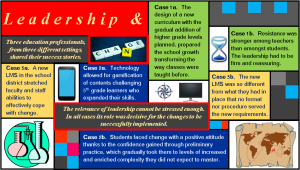
Change is constantly occurring as the information from contacts in my network demonstrate.

Click below on the name of the graph to open the file, enable editing, and then run the presentation to display its animation.

LRNT525 Leadership n Change Infographic

Case 1.  Change of curriculum & expansion of grade levels.

This is the case of an EC-9 school that had plans to expand to an EC-12 school.  The identity of the school and the people involved shall remain undisclosed.  Usually changes to the school’s curriculum even when mildly complex might require some adjustment in addition to teachers’ training.  In this case the new curriculum represented a serious challenge: first, the content of all subjects would be organised differently; second, the  classes would be oriented to be hands-on learning; and third, the teachers would act as coaches allowing the learners to be in the driver’s seat.

The initiative for this change came from the school’s principal, and it took a great effort on every level to get it started.  To begin with there was the school board to approve the project.  Then administration and, most importantly, faculty had to adopt the idea because organisational readiness is fundamental for a change effort to be successful in any organisation (Weiner, 2009).  Parents had to understand the project’s vision and the commitment needed to succeed.  And last but not least, the student body had to be involved too due to each adolescent having their voice heard at home regarding where  to study high school.  Existing high schools increased the challenge of the project.

Several factors were key for the success of the effort.  Training teachers to perform in a maker-space setting helped them break paradigms to accept and experience innovation.  Active involvement of students included them participating in the design of a new cafeteria which gave them sense of ownership towards the new high school.

As Weiner asserted it: “The content of change matters as much as the context of change” (Weiner, 2009) could not have summarized the project better, and without the intense leadership exerted by the school’s principal the effort would have failed.

Case 2.  Gamification.

As they enter the room, the students in Mr. Magallon’s 5th grade class ask the question right after greeting their teacher: “Do we get to play Kahoot! today?”  Kahoot! is a free game-based learning platform that makes it fun to learn – any subject, in any language, on any device, and for all ages (2018).

Mr. Magallon regarded the gamification successful because oftentimes previously unengaged students ask him for a Kahoot! link to play at home.  He then realised game-based made a difference.  Kahoot! got students plugged into learning, helped them improve mastery of complex science topics, fostered social learning, unlocked learners’ potential, and deepened pedagogical impact (2018).

Leadership was modelled by Mr. Magallon when he played with the students for the first time.  Kahoot! is played in teams rotating the leader role, who coordinates the team and voices their answers supported by the team-debated arguments for which the students practiced collaboration skills.  By placing the learners in settings that make them think critically to solve problems or arrive to solutions, game-based learning becomes as effective as project-based learning (Farber, 2016).

Case 3.  New Learning Management System. 

Although the need of a new Learning Management System (LMS) was obvious, the change took most teachers and staff by surprise because the system became operative a few days before the first day of classes which meant the old system to be gone.

It took the principal, the assistant principal, and the computer lab teacher a lot of hours to provide in-classroom support to every teacher in campus in order to get the school running with the new LMS.  Names not to be disclosed.

Due to the sudden start the only training available was on the fly, and the difference people was having started as early as calling attendance, which now was done with the system.  Pen-marked rosters sent to the office before 9:45 a.m. were a thing of the past.

At some point during the daily support of teachers, the  principal instructed his team to concentrate on aspects of the LMS that were essential to the school’s daily operation, and forget about other features not needed in the short term.  The principal followed a strategy that resonates with Feldstein (2017) who described that any LMS is likely to be built as a series of add-ons to an original idea, which ends up saturated with added features that cause the core functionality to be hidden somewhere.   Miller (1982) postulated that an incremental approach can be a cost-effective manner of facing change that provides for stages of stabilization, and this resembles what the principal asked his team to do.

References

Farber, M., (2016). Gamify your classroom. The Education Digest 81(5), 37-42.

Feldstein, M., (2017, May 28). A flexible, interoperable digital learning platform: Are we there yet? [Blog post].

Magallon, D., (2018). E-mail to Alfonso Mac Gregor, sent from Sam Houston Elementary at P.A.I.S.D., Port Arthur, TX.

Miller, D., ( 1982 ). Evolution and revolution: a quantum view of structural change in organizations. Journal of Management Studies 19(2): 131 – 151.

Weiner, B. J., (2009). A theory of organizational readiness for change. Implementation Science4(67).
What is Kahoot! (2018). Retrieved from https://kahoot.com/what-is-kahoot/

LRNT525 U2 a2 – Successful Change

Technology-based renovating processes

First, “F” stands for Failure…

As a typical example of globalization a multi-national corporation was expanding rapidly to other countries, thus experienced an urgent need for qualified employees viable for relocation.  In full concordance with the statement that “what this globalization means for business-people is that the need to interact with people who are culturally different has never been greater and will only increase in the future” (Thomas & Inkson, 2008), thus the company regarding the assimilation of a foreign culture as key for the success of the relocated employee as well as the expansion projects was right but something happened during implementation.  The human resources department hired an external consultant firm to identify the candidates in all areas of the company that would make a good fit for the openings.  The consultant firm installed their surveying system on the corporation’s platform making it company-wide available, although  the access to the system was granted on a personal basis.

Once invited through a formal letter that explained the details of the expansion project and the procedure to gain access to the consultant’s system, each candidate had to train herself/himself on how to use the system, and that self-training was performed only with the guidance of the system’s directions displayed on the screen.

There were several pieces missing in this effort.  First, the invitation letter was the only information the employee received regarding what  the  corporation was doing.  In a different context, a personal letter from the company would be extraordinary in itself but in this case it lacked the human touch to allow the person to interact with someone that could provide more meaning to the content.  The corporate effort to anticipate the availability of qualified individuals depended on a surveying technology that, according to Shneiderman, should be in harmony with the users’s needs while enriching their experiences with support of their relationships and activities (2003).

Second, due to the objective of the survey several questions explored subjective aspects with regard to the adaptability of the candidate.  The study was delicate because it required that information.  Nonetheless, the answers were interpreted solely by the consultant firm’s staff thus lacking  the context of each candidate in order to properly understand the answers.  There were several cases of inexact results caused by that situation which generated conflict.  Which, again, proves that information technology is most valued when it provides the user with a sense of security, mastery, and achievement (Shneiderman, 2003).

And third, being the process a  direct invitation to participate not everyone in the company received a letter.  Regardless of the criteria to select whom shall receive such letters which only top management levels knew, the project was informally -although perhaps rightly so- stigmatized as discriminatory.

Even though there was a personal written communication, it was not enough nor correctly used.  The leader in charge of the change process must constantly communicate the objective of changing to all in the company, and those acting as change agents should plan on how to bring about such communication (Biech, 2007).

Second, “S” stands for Success…

The state of Texas in the U.S. is divided in 20 geographic regions.  Each region includes public school districts and public school charters.  Region 4 encompasses 48 public school districts and 34 open-enrollment charter schools, representing more than 1.2 million students, 95,000 educators, and 1500 campuses.  Half of the student population is of Hispanic origin, and 22.3% of the total of students are English Language Learners.  This supports the importance of having a bilingual program in place (Wells, 2018).

Region 4, in coordination with local universities, had the Alternate Certification Program (ACP) taught in several cities of Mexico, during which the instructors travelled from the US to the Mexican locations on weekends back and forth for the ten months the program took to complete.  When physical security started to be an issue in Mexico, Region 4 looked for ways to avoid exposing their staff thus enabled an online version of the ACP which was gradually implemented.

The moderate introduction of the online version of the ACP helped the students as well as the instructors, since similar to the conductor’s full involvement needed for the flawless performance of the orchestra, the instructors had to actively pay detailed attention to achieve effective engagement of all students.  The ACP acquired a new dynamic thanks to both, the online asynchronous interactions amongst learners and instructor, and the Blackboard synchronous sessions.

Leadership was fundamental because the involvement demonstrated by the instructor over the gradual shifting of the program allowed the students to assimilate the way the class would be online and, at the same time ask questions receiving the coaching needed to take off with the new version.

Two things were evident: An immediate and natural resistance to change, and the absence of the human contact provided by face-to-face sessions.  As the weeks went by the quality of online interactions together with the constant participation of our instructor (which not necessarily happened in other groups) helped the learners assimilate the transition, and succeed in the program without the feeling of something lacking in the process.  I credit our instructor fully for that result due to her authentic rapport with the group.

We recognized our instructor’s merit of having each one of us actively collaborate with one another, regardless of how each one was presenting their work on screen.  This has to do with assimilating the shared notion of digital environments as mentioned by Feldstein (2017), and by achieving this she broke more than one paradigm in her students’ minds.  When we were done with one assignment we were already eager to peek into the next assignment in order to share our work with other peers and exchange opinions and comments.  That degree of interaction is not easily accomplished.

References

Biech, E. (2007). Models for change. Thriving Through Change: A Leader’s Practical Guide to Change Mastery. Alexandria, VA: ASTD

Feldstein, M. (2017, May 28). A flexible, interoperable digital learning platform: Are we there yet? [Blog post]

Shneiderman, B., (2003). Leonardo’s laptop: Human needs and the new computing technologies. MIT Press. ISBN: 9780262692991

Thomas, D., & Inkson, K., (2008). Cultural intelligence: People skills for global business. ReadHowYouWant.com (Ed). ISBN 1442953861, 9781442953864

Wells, P., (2018). Retrieved from http://www.esc4.net/about/about-region-4