Golddiggers: Well, that’s too easy

Team 3: Golddiggers

Well, my pop music choice for this is too easy, especially given that this group presented on TikTok! Discussions on music sampling and using that to teach music history are also a good link between TikTok and podcasts, which was the topic of Team 5’s presentation. I have thoughts on the use of podcasts for education, but that will have to wait for a later blog post.

I loved this group’s chosen topic, TikTok in education. The comment that I posted on Stephanie’s blog about TikTok being largely unverifiable, based on their presentation, and Stephanie’s reply about there being a new application around the corner for our kids (we have kids about the same age) rings very true (Messier, 2022). The concept of nano-learning was really interesting to me as well. I wonder how much smaller learning credentialling will get, but that is a question for another time.

For now, I want to focus on learner motivation in organizational learning that Stephanie discussed (Messier, 2022). Adnan et al. (2021) discussed listening comprehension. As a language learner myself, I. know how important comprehension is to be able to communicate to others, especially in another language than one’s mother tongue. A TikTok example of this is Dave Poirier, a Canadian teacher that I follow on TikTok. He quite cleverly uses student engagement with pop music in listening comprehension, as the following clip shows (Poirier, 2022):

You can see in the background that he positions his camera so that viewers can see his social media coordinates, as well as how long it has been since he forgot to take attendance. I know from watching my own son in Grade 8 admire his cool Social Studies teacher who played Toto’s ‘Africa’ in class how much impact these kinds of teachers have. I agree with Stephanie’s assessment that workplaces owe it to their future generations to at least explore TikTok seriously.

References:

Adnan, N. I., Ramli, S., & Ismail, I. N. (2021). Investigating the usefulness of TikTok as an educational tool. International Journal of Practices in Teaching and Learning (IJPTL)1(2), 1-5. https://ir.uitm.edu.my/id/eprint/52140/

Messier, S. (9 May, 2022). Reflection on TikTok in education – Stephanie’s Blog. From https://malat-webspace.royalroads.ca/rru0225/reflection-on-tiktok-in-education/

Poirier, D. (27 Februarym 2022). Dave Poirier on TikTok. TikTok. From https://www.tiktok.com/@teachpoirier/video/7069394139367984389?_t=8SGFvo5EYTN&_r=1

Fab 4: Revolution

Now that I’ve seen all of the presentations (including my own team), I have a lot of thoughts that I am sure will just make my own paper more difficult! I have also gotten away from my early efforts to search for a way to link my love of pop music with blog posts, so I will go back to that in an effort to ameliorate my current mood!

Team 4 was the first team to present. They chose an e-learning course with a very clever name, ‘Hoarding Frogs in a Wheelbarrow’ (which does not sound easy!). It sounds like an interesting premise for a learning event and I think the observation that it is curated by only one person, thereby leaving it open to bias, is a valid one.

The team’s individual projects are as follows (Chaddock, 2022, para. 8):

  • “Alisha: How does engagement through social presence affect cognition?
  • Ben: How does the resource utilize constructivist and behaviourist learning methods?
  • Melissa: How do misinformation and bias affect resource quality (credibility & accuracy), especially when community members are encouraged to contribute?
  • Sharmila: How do we define quality? Who gets to define quality?”

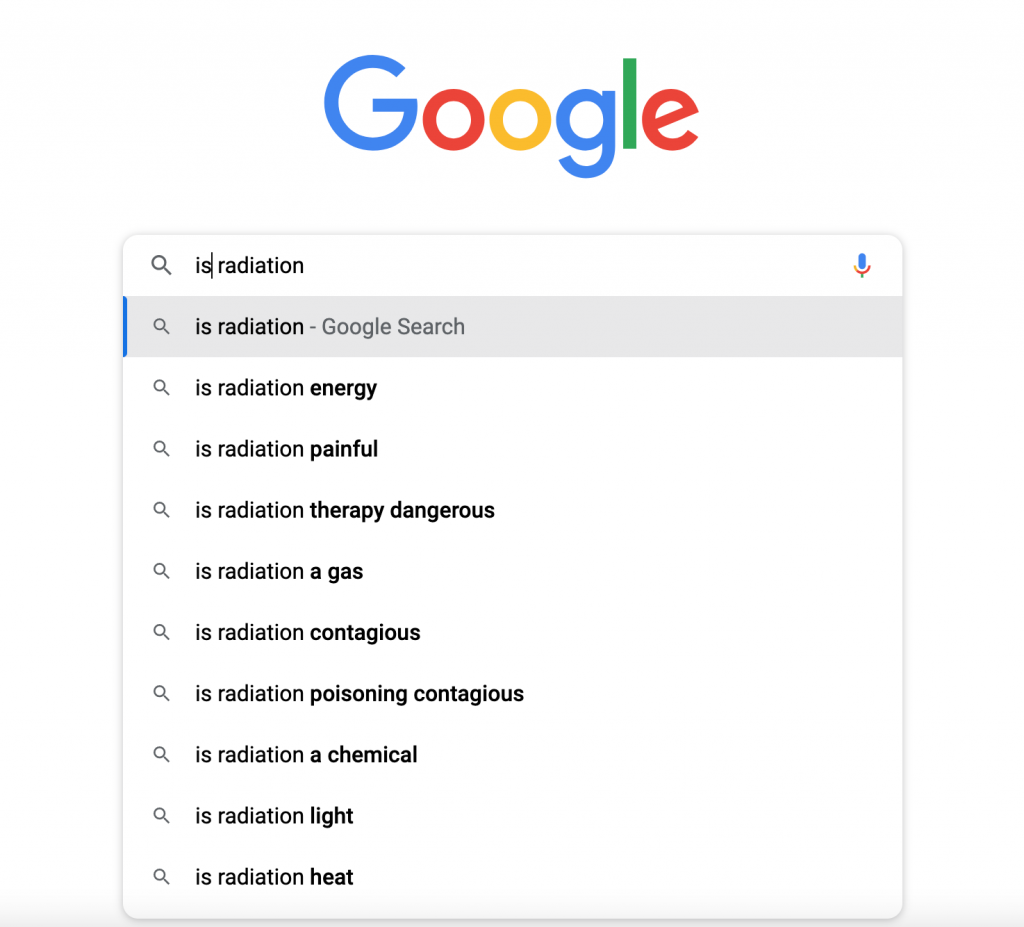
I really resonate with Melissa’s question about bias. Misinformation and bias relate quite closely to regulatory capture that I am investigating in my own research. I work in the nuclear industry and if I do the same search that Caulfield (2017) mentioned, but starting with ‘is radiation’, I get Figure 1:

Figure 1. Google search for ‘is radiation’. Houldsworth, 2022.

His solution to combat misinformation with info-environmentalism is a good one, I think. As experts in our fields, we can combat online misinformation with the concrete examples he gave; updating Wikipedia, posting factual information, and answering questions on fora (Caulfield, 2017).

I want to take this to my own project and consciously work to spread factual information in an effort to combat the misinformation that is so prevalent.

References:

526.1.3 – Team Blog – Ben’s Blog. (18 April, 2022 From https://malat-webspace.royalroads.ca/rru0206/2022-04-18/

Caulfield. (23 October, 2017) Info-Environmentalism: An Introduction. From https://er.educause.edu/articles/2017/10/info-environmentalism-an-introduction

Extended Reality Introduction

On this Easter weekend, with family visiting from France and my mother in isolation due to rising COVID cases in her community, I’ve struggled to meet these deadlines. I’m here now though and have just realized as I write this that I have been using our chosen technology for a while.

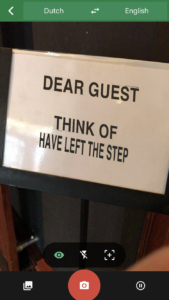
The issue that we are interested in exploring is Augmented Reality (AR) in education. The technology sounds amazing and has a lot of promise, but like a lot of technology, there are downsides, or rather risks that need to be managed. My experience with AR so far is limited to work travel. I traveled to The Netherlands in 2019 for work. I speak absolutely no Dutch, so I downloaded the Dutch language package for Google Translate on my cell phone. Some of the translations were a little off, as this warning about a step down in a hotel restaurant shows (Figure 1).

Figure 1. Warning in hotel restaurant. Houldsworth, 2019.

What I learned from other translations was deeper, as shown by this poster in the Resistance Museum. I invite readers to use their own application, whether Google Translate or a different one, to translate this happy family image and let me know your thoughts on its intent.

Figure 2. World War 2 German propaganda poster. Verzetsmuseum Amsterdam, taken 2019.

The ability of a machine to communicate powerful ideas in live time intrigued me. At the same time, the strange translations showed me that the technology is only as good as its inputs. When I helped my in-laws download the same application this weekend so that they can be more independent as they travel around our very anglophone town, the looks on their faces as they realized the power of the application was tempered by the privacy warnings that Google includes when the user gives permission to save conversations and photo translations.

Ostensibly, Google wants to improve its translations and algorithms, but with that comes the need to allow Google access to users’ searches to provide training for the algorithm. Depending on what the user inputs, Google potentially has access to some very private information. Hotly debated in whether a massive company like Google, with such huge market share, is fairly using users’ data and providing equitable results (Cossiavelou, 2018). Also risky is the quality of translation when the application is used for critical instructions. According to one paper, “Google Translate has only 57.7% accuracy when used for medical phrase translations” (Patil & Davies, 2014), which leads us to conclude that machine translations are not yet as good as or better than human translators.

Our team, the Extendables, have decided to choose Augmented Reality (AR), or rather Extended Reality (ER) (hence the team name!), for our learning event and delivery technology. Our group chose a relatively new application called Jigspace that was created by an Australian duo in 2014. Since then, Jigspace has developed quite a few impressive networks using their technology, most recently with Alfa Romeo. Jigspace wants users to be able to create a team with which creators can share 3D information. The paid version of the software uses uploaded Computer Aided Design (CAD) files, common in design and manufacturing, to render 3D images that the application can project onto a camera’s viewer. The images projected wind up looking very much like Pokémon GO images,but instead of cartoon monsters, users can explore how a toaster works, or how an Alfa Romeo Formula 1 (F1) racecar works. A recent software update has also added sound files so that users can hear how the Jig, as the output is called, sounds. I look forward to exploring more about Jigspace’s evolution, its current uses, and its future plans, as well as trying to exploit its weaknesses.

References:

Cossiavelou, V. (2018). Global Regulations in Content Industries: The Google Privacy Policy as a News Gatekeeping Factor. International Journal of Interdisciplinary Telecommunications and Networking, 10(3), 9–20. https://doi.org/10.4018/IJITN.2018070102

Patil, S., & Davies, P. (2014). Use of Google Translate in medical communication: Evaluation of accuracy. BMJ, 349(dec15 2), g7392–g7392. https://doi.org/10.1136/bmj.g7392

Team posts:

Paula: https://malat-webspace.royalroads.ca/rru0221/investigating-the-reality-of-virtual-reality/

Zac: https://malat-webspace.royalroads.ca/rru0226/lrnt-526-%e2%94%82extendable-team1-activity-3-on-jigspace/

Katia: https://malat-webspace.royalroads.ca/rru0213/activity-3-individual-blog-post-specific-issue-exploration/

I Can See the Light

My initial post on leadership based on our group work identified the following top five attributes of leadership:

      1. Competent,
      2. Honest,
      3. Dependable,
      4. Straightforward, and
      5. Supportive.

I still agree with these.

This exercise was a good one for identifying our group dynamics and getting to know how this group would work together. I had worked with most of our members before in other groups, but this would be different. Each group or class has its own personality, which was one of the interesting things that I discovered when I did my interview for Assignment 1. That was good reinforcement for something that I had identified years ago in classroom management when I was teaching trades courses.

In my current role, I am not a teacher, nor a corporate trainer. Due to my place on our union local executive and now the Policy Health and Safety Committee (PHSC) in my workplace however, I have made myself known as a willing volunteer with a background in instructional design with which I can benefit the organization. I hope that this shows an ability to lead, without occupying a management level position. Based on the information I outlined in Assignment 3, I still intend to submit my plan for amending the harassment and violence in the workplace training in the upcoming fiscal year that starts on Friday. I hope to be able to deliver a quality project that engages my colleagues and improves our workplace overall. Planning based on research gives me hope that this change initiative won’t fail and we’ll be better for it.


And speaking of leadership…

https://www.youtube.com/watch?v=RfinvuRolR0

It’s The End Of The World As We Know It (and I don’t feel so good)

Conway et al.’s 2017 paper entitled “From Design Thinking to Systems Change” (Conway, Masters, & Thorold, 2017, p.1) spoke most directly to me out of all the readings for this unit. In 2019, the organization for which I work started to undertake a “comprehensive review” of its work (CNSC, 2020), called Project Athena. It is expected to be complete in fiscal year 2021-2022, according to Departmental Reports, which are filed in the Parliament of Canada through the Minister of Natural Resources (CNSC, February 2021). The goals of the project align with the organization’s four strategic priorities, specifically the “agile” pillar (CNSC, n.d.). As one of the early activities in the review, all staff were invited to design thinking sessions where they were canvassed to see what they thought needed to be changed. As a staff member, having my input requested was novel and refreshing.

The design thinking sessions were open exercises where nothing was off limits. They were “substantial and varied” as Conway et al. discussed (Conway, Masters, & Thorold, 2017, p. 7). Hundreds of ideas were generated and many of these were actioned quickly, especially in situations where there was little to no cost involved and the changes were expected to negatively affect other areas. The rest have been categorized and folded into a project plan that will be actioned by senior management, in coordination with a management consultant (Government of Canada, n.d.).

From my point of view, the “think like a system, act like an entrepreneur” approach (Conway, Masters, & Thorold, 2017, p. 9) seems to have been followed. My hope is that the barriers identified by Conway et al. do not cause the project to fail or slow down. The way that these types of complex systems “mired in complexity” (Conway, Masters, & Thorold, 2017, p. 10) can hit barriers to change, such as regulatory frameworks, media backlash, and cultural norms and send “the innovation back to square one” (Conway, Masters, & Thorold, 2017, p. 13). Specifically, the media backlash and cultural norms noted by Conway et al. in 2017 could not have seen 2020-2022 coming.

This year has shown unbelievable challenges to the project that make Conway et al.’s statement describing the reality of the “route from innovation to scaling” being “fraught with obstacles” (Conway, Masters, & Thorold, 2017, p. 12) as the understatement of the epoch. As I write this, the neighborhood in which the organization’s headquarters in Ottawa, Canada sits has just been cleaned up from a month’s long occupation ostensibly related to the COVID-19 pandemic (Paperny, A. M, 3 March 2022). The Doomsday Clock sits at 100 seconds to midnight (Bulletin of Atomic Scientists, 20 January 2022), although this is likely closer to zero, given the war in Ukraine and recent shelling of the Zaporizhzhia nuclear power plant (AP News, 4 March 2022). Given that my organization stands ready “to offer coordinated support” (CNSC, 4 March 2022, para. 3) to the international nuclear regulatory community in these tense times, all these external barriers to change could certainly derail such an ambitious project as Project Athena. I hope that since Canada already “a mature, well-established nuclear regulatory framework” (CNSC, 2020, para. 2) and Project Athena is a further push for regulatory excellence, rather than a shoring-up of foundations, we may experience a slowing of the project rather than a “system immune response” (Conway, Masters, & Thorold, 2017, p. 13). I know that my own practice will be informed by international and domestic events, and they have taught me how fast things can change.

In summary, we are experiencing incredible barriers to change and the future will show how much impact these will have my organization’s change project.


References:

AP News. Russia attacks Ukraine nuclear plant as invasion advances. (2022, March 3). https://apnews.com/article/russia-ukraine-war-a3092d8e476949ed7c55607a645a9154

Bulletin of the Atomic Scientists. (n.d.). Current Time—2022. Retrieved March 5, 2022, from https://thebulletin.org/doomsday-clock/current-time/

Canadian Nuclear Safety Commission (CNSC). (2021, August 16). Canadian Nuclear Safety Commission (CNSC) Annual Report 2020–21. http://nuclearsafety.gc.ca/eng/resources/publications/reports/annual-reports/ar2020-2021/index.cfm?pedisable=true

Canadian Nuclear Safety Commission (CNSC). (2021, January 27). 2021–22 Departmental Plan. https://www.nuclearsafety.gc.ca/eng/resources/publications/reports/rpp/dp-2021-2022/index.cfm

Canadian Nuclear Safety Commission (CNSC). (2022, March 4). CNSC Statement on the ongoing situation in Ukraine[Statements]. https://www.canada.ca/en/nuclear-safety-commission/news/2022/03/cnsc-statement-on-the-ongoing-situation-in-ukraine.html

Conway, R., Masters, J., & Thorold, J. (2017). From design thinking to systems change. How to invest in innovation for social impact. RSA Action and Research Centre.

Government of Canada. (2020, September 24). Management Consulting Support for Project Athena: CNSC Strategic Review (5000049497/C). https://buyandsell.gc.ca/procurement-data/tender-notice/PW-20-00927612

Paperny, A. M. (2022, March 3). Ottawa police misjudged protesters who besieged Canada’s capital—Testimony. Reuters. https://www.reuters.com/world/americas/ottawa-police-misjudged-protesters-who-besieged-canadas-capital-testimony-2022-03-03/


Digital Leadership Reflections

For posterity, I am starting this post with a reminder to myself that I am now sick (likely COVID, but rapid tests keep coming back negative), brain foggy, and this is the second weekend in a row that fascists have been trying to overthrow the government in Canada. Note to self: look back on this later and comment about how it all turned out, as well as make a note about how different areas of the country reacted and which ones were most successful. I am also tired of starting posts with “over the past two years”, but the past two years are looking like a way of gauging how well previous predictions have panned out.


First, my thoughts on our team activity and the research-informed results:

Our group identified the following as our Top Five attributes of leadership:

      1. Competent,
      2. Honest,
      3. Dependable,
      4. Straightforward, and
      5. Supportive.

Of the top four research-informed rankings, our group agreed with two: honest and competent.

We held one synchronous meeting and worked via Google Docs. At that meeting, we talked about how we experience leadership, rather than how we lead, which was interesting in hindsight. Our discussion revolved around how we wanted to be perceived as leaders because of how we perceived leaders we have had. We also talked about how leaders need to lead, and doers need to do. I think that our choices were informed by our composition. As a group comprised entirely of women, we also put a lot of focus on consensus, rather than debating and influencing others to our point of view, as I have experienced in groups with majority male membership. After thinking about this more for a few days, I think that our point of view as followers showed that we may not think of ourselves as leaders in a Eurocentric way (e.g. male-dominant, hierarchical). That has changed how I want to approach this course; I want to improve my leadership practice by influencing, rather than learn how to lead. We are all leaders already.

Next, my Leadership Reflections

For this post, I want to focus on leadership, competence, and dependability. These were the most important leadership attributes that stood out to me from our top five. Our list was not identical to the research-informed list, but we had a starting point, which allows us to develop from there.

The reflection prompts talked about thinking about what it means to be a “digital leader”, but I doubt it matters whether we lead in a digital space or in a face-to-face space. Leadership is leadership. Right now, and I would argue going forward, the difference is in how strong the leader’s digital skills are. To trot out my cliché again, “over the past two years” many leaders’ weak digital skills have been laid bare. Before, they might have been seen as great leaders when the tools they had at their disposal were elevator talks, in-person reading of body language, and the informality of being able to pop into someone’s office. Now, the tools they have available are only digital and if their digital skills are weak, they are hamstrung. For example, they are unable to read body language as effectively if they cannot figure out how to set up a microphone and camera. Sheninger’s point is valid when he says that “establishing relationships” (2019, para. 6) initiates sustainable change. You can certainly establish relationships digitally and then work on that change. I have done so. If you cannot figure that out using the digital tools that are the only thing you have at your disposal, you cannot be successful. Leaders who are competent also experience success.

Some leaders that I have observed have used the “ubiquitous connectivity” afforded by digital that Shenigner (2019, para. 6) described to their advantage. In digital learning, being able to leverage this level of connectivity can provide a sense of competence if leaders working in DLEs discover clever ways to use the technology available to their organizations to remain connected and responsive to learners as they build influence. Being digitally connected also means being able to maintain that connection, which leads to dependability.

The partnership, protection, and participation that Fitzgerald (2003) talked about leads to dependability that followers need from their leaders. I was intrigued by the issues that Fitzgerald discussed about “women’s leadership” (Fitzgerald, 2003, p.10) and how discussion around female indigenous leadership is absent. I was disappointed that it is seen as an alternative and not a matter of fact. It was also disappointing that research on the intersection of gender and race in educational leadership has been so marginalized and focused on (usually male) individuals (Fitzgerald, 2003).

While my thoughts on the most important attributes of digital leadership and those of my team varied from the research-informed ones, we were all very able to identify those that were important to us, which is the first step in being able to reflect on what we want to be.

References:

Fitzgerald, T. (2003), “Changing the deafening silence of indigenous women’s voices in educational leadership”, Journal of Educational Administration, Vol. 41 No. 1, pp. 9-23. https://doi.org/10.1108/09578230310457402

Pillars of Digital Leadership. (2019, December 20). International Center for Leadership in Education. https://leadered.com/pillars-of-digital-leadership/

Elements of Design

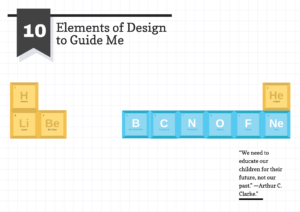
For the final assignment of LRNT524, we were challenged to come up with a “manifesto”, or visual representation, of design elements that we feel are important in design work. This was based on the team assignment from my previous post, as well as feedback from other students in the program.

Here are my elements of design. I chose elements rather than manifesto as a nod to my science background.

LRNT524 – Design Thinking Challenge (Partners)

This was a really interesting assignment and one I wish we could have tested in real life! My partner for this assignment was Myrna Pokiak. Her blog can be found here.


Introduction

Integration of Indigenous ways of knowing in a learning context was the focus of our design thinking challenge. We used the process described by the d.School Design Thinking Process, part of the course materials for LRNT 524. We challenged ourselves to radically reimagine the design of digital learning environments (DLEs) for Indigenous learners and realize the potential of critical instructional design in practice by closing the education gap between Indigenous and non-Indigenous students. Closing the education gap has been shown to have benefits for improved earnings potentials as well as reduced cultural dissonance (Howe, 2011). Our solutions, which we have termed revolution instead, includes three main points that we propose to test: access, story mining and preservation, and acceptance of oral traditions in academia. 

Revolution One: Access

Access and reliable high speed internet is crucial for Indigenous learners to benefit from  DLEs. Without reliable access, there will continue to be a lack of Indigenous users for a DLE. As Anthony & Keating highlighted, Australia has seen some progress and has shown how urban versus rural access is not simply a matter of physical access, “what is a positive force for non-Indigenous urban communities must also be good for remote Indigenous communities” (2013, p. 5, para 3). The cultural differences between people who live in urban versus rural settings must be taken into account when attempting to design DLEs.

In comparing internet access across Canada, it is valuable to view the Indigenous populations, with the highest percentage of Indigenous versus non-Indigenous (Figure 1), and compare with internet access across the same geographic regions (Figure 2). This comparison shows a true visual of limitations for regions with the highest Indigenous populations per capita across Canada and the inequality that continues to exist.

Figure 1 

Percentage of the Indigenous population by Province/Territory

Note. The data are from Indigenous Services Canada, Government of Canada. (2020). 

Figure 2 

Internet Service inCanada

Note. The data are from Innovation, Science and Economic Development, Government of Canada (2019). 

Radical ways to meet user’s needs for Access 

  1. Tie regulatory approvals to funding for broadband. Resource exploration companies need not be internet network builders, but must be viewed as necessary partners in the development of remote communities for development of DLEs if they intend to continue to exploit these remote areas for resources such as oil and gas, diamonds, or uranium. 
  2. The Government of Canada must honor the 94 Calls to Action (TRC, 2015) and hold itself accountable, considering the mass deconstruction of Indigenous society through stolen unceded land (McIntosh, 2020), water, and resources. One example to achieve the sixth to 12th Calls to Action, would be the investment in internet access throughout Canada and implement swiftly to bridge the gap that currently limits users, particularly in rural Indigenous regions as illustrated in Figure 2. 


Revolution Two: Mining the Elder Populations for their Stories

Judy Iseke and Sylvia Moore have worked to develop Métis storytelling as pedagogy and research practice (Iseke & Moore, 2013). Elders need not have access to technology themselves. This can be provided for them so that their learnings can be captured and used later, as Iseke and Moore did in their Presenting ourselves to/in the Museum project (Iseke & Moore, 2011). 


Radical ways to meet user’s needs for Mining the Elder Populations for their Stories 

  1. Implementation of a technology space in Indigenous elders’ facilities to connect with learners throughout the world, would provide access to wisdom and elders knowledge. This would improve mental health strengths for elders and provide access for learners to connect with elders’ and knowledge through DLEs. Imagining access that is attained through oral history and connecting with elders who are natural storytellers, the technology space would encourage dialogue and offer opportunities for interviews, documentation, preservation, and teaching. A respected Inuvialuit elder, Randall Pokiak described the role of elders best in his last documented film about the current pandemic, “the elders’ responsibility is, we’ll protect you, we’ll teach you how.” (Code, 2020, 11:40 to 13:23). Elders crave to share their knowledge. In DLEs and underutilized elders facilities, the link between sharing elders’ wisdom with learners becomes possible.

Revolution Three: Working on Acceptance and Academy for Oral Traditions

Euro-centric educational models are not the only acceptable means of teaching. Oral traditions and their associated cultures of learning are valid alternatives (Iseke, 2013). Indigenous teaching traditions being studied by the Gabriel Dumont Institute and the Saskatchewan Urban Native Teacher Education Program (SUNTEP) (SUNTEP, 2013) are involving elders in education and focusing on supporting elders “to build relations and to create ethical space where learning and sharing can occur.” (Goulet et. al., 2009, p. 2).

We agree with Morris when he says that instructional design should “give platforms for those voices most usually suppressed or oppressed” (2018, para.7). Part of this work involves repatriating indigenous artifacts from their various colonial holdings around the world (NBC, 2021).  Elders can develop rich DLEs to teach the artifacts’ history in context, as is being done in the Inuvialuit Pitqusiit Inuuniarutait (Inuvialuit Living History) project (CBC, 2020). Combined with Indigenous Digital Storytelling as described by Iseke & Moore “to teach youth their cultural traditions and the Western skills that will enable them to work in the wider world” (2011, p. 21), an alternative to the currently practiced Eurocentric model of written word and culturally appropriated teaching can be developed that is authentic, decolonized, and comes directly from the people who own it, rather than filtered through a western academic lens. 

Radical ways to meet user’s needs to work on Acceptance and Academy for Oral Traditions 

  1. Development of Indigenous resource websites, based on regions and representing all Indigneous groups, similarly to the Inuvialuit Digital Library (2014), collaboration between the Inuvialuit Cultural Resource Centre and the University of Alberta. The creation of a National Indigenous website with links to each Indigenous region, would allow direct digital access to documented stories, visuals, and information from Indigenous perspectives, essentially taking the Native Land (2021) website one step further so when an Indigenous group is visited, links to websites like the Inuvialuit Digital Library become available.
  2. Repatriate artifacts such as the MacFarlane Collection that is currently housed in the Smithsonian Museum in Washington, DC (CBC, 2020) and provide resources to develop culturally appropriate learning resources.

Conclusion

This design thinking challenge was a good opportunity to stretch our thoughts on possibilities to close the education gap between Indigenous and non-Indigenous learners and how that can happen. We were able to use the process to dig deep into what learners need to successfully participate in DLEs and build solutions to close the gap. We feel that reliable access, story mining and preservation, and radical acceptance of oral traditions are possible solutions for Indigenous learners who are survivors and as Wilson-Fontain put it, “thrivers” (Monkman, 2019).

References

Anthony, S. G., & Keating, M. S. (2013). The difficulties of online learning for Indigenous Australian students living in remote communities–it’s an issue of access. Online Journal of Distance Learning Administration, 16(2).

Australian Broadcasting Corporation. Stuff The British Stole. (n.d.). [Collection]. Retrieved January 1, 2022, from https://www.abc.net.au/radionational/programs/stuff-the-british-stole/

Canadian Broadcasting Corporation. (2020, August 10). “All his wisdom will be missed”: Lifelong Inuvialuit advocate dies at 71. CBC News. CBC. https://www.cbc.ca/news/canada/north/randal-boogie-pokiak-inuvialuit-obituary-1.5680097

Code, Allan. (2020). Pandemic – at the end of the world. [National Film Board of Canada]. https://www.nfb.ca/film/pandemic-at-the-end-of-the-world/

Goulet,  L., Pelletier, J., Pete, S., Racette, C., Longman, S. Goodwill, K., & Fayant, R.  (2009). Asokan  (The  Bridge)  Teachers’  Work  with  Elders.  Saskatoon:  Dr.  Stirling  MacDowell Foundation for Research Into Teaching Inc., Project #188.

Hotte, N., Nelson, H., Hawkins, T., Wyatt, S., & Kozak, R. (2018). Maintaining accountability between levels of governance in Indigenous economic development: Examples from British Columbia, Canada. Canadian Public Administration, 61(4), 523–549. https://doi.org/10.1111/capa.12287

Howe, E. C. (2011). Mishchet aen kishkayhtamihk nawut ki wiichiihtonaan: Bridging the aboriginal education gap in Saskatchewan. Gabriel Dumont Institute.

Indigenous Services Canada, Government of Canada. (2020). Annual Report to Parliament 2020. https://www.sac-isc.gc.ca/eng/1602010609492/1602010631711 

Innovation, Science and Economic Development, Government of Canada (2019). High Speed Internet Access for All: Canada’s Connectivity Strategy. https://www.ic.gc.ca/eic/site/139.nsf/eng/h_00002.html 

Inuvialuit Cultural Resource Center and University of Alberta. (2014). Inuvialuit Digital Library. https://inuvialuitdigitallibrary.ca/collections 

Iseke, J., & Moore, S. (2011). Community-based Indigenous Digital Storytelling with Elders and Youth. American Indian Culture and Research Journal, 35(4), 19–38.

McIntosh, Emma (2020). What it means when we say Indigenous land is ‘unceded’. Jan 24, 2020 Podcast. Canada’s National Observer.  https://www.nationalobserver.com/2020/01/24/analysis/what-we-mean-when-we-say-indigenous-land-unceded 

Monkman, Leonard. (2019). From survivors to ‘thrivers’: former residential school students connect with culture and each other. CBC News. Retrieved January 1, 2022 from https://www.cbc.ca/news/indigenous/residential-school-survivors-thrivers-1.5296107 

Morris, S. M. (2018). Critical Instructional Design. In An Urgency of Teachers. Pressbooks. 

Europe returns looted African treasures as it reckons with colonial past. (n.d.). NBC News. Retrieved January 1, 2022, from https://www.nbcnews.com/news/world/europe-returns-looted-benin-bronzes-africa-reckons-legacy-empire-rcna3986

Native Land. (2020). Native Land Digital. WordPress. https://native-land.ca/ 

SUNTEP (Saskatoon, Sask.), & Gabriel Dumont Institute of Native Studies and Applied Research (Eds.). (2013). “Be bold! Move forward!”: Measuring success. Gabriel Dumont Institute.

Truth and Reconciliation Commission of Canada (2015). Truth and Reconciliation of Canada: Calls to Action. https://ehprnh2mwo3.exactdn.com/wp-content/uploads/2021/01/Calls_to_Action_English2.pdf