Lovefool


From the early part of the 21st century, lovers have been placing “love locks” on bridges, railings, or other structures. They write the lovers’ names on the lock and throw away the key to symbolize the unbreakable love between them. This is not a discussion on whether this constitutes vandalism or not, but rather a metaphor for instructional design (ID) practice and tools.

In 2007, when I first started teaching certification courses for Exposure Device Operators (EDOs), I was handed a stack of overhead slides and the keys to the classroom for an already successful course. Over the next eight years, I took that material and, with the assistance of ID training I sought out and implemented, added various other tools that made that training course one of the most successful in Canada.

To visualize the tools, imagine a bridge or railing connecting two things: the learner before they begin learning about exposure devices and the learner after they successfully complete the training course and become certified. Each “lock” on that railing or bridge is a strong ID tool that I placed there using one of my superpowers (Meyers, 2020). It has the name of a learner on it who inspired the use or development of the tool and it is visible to the learners who come along later and see it there. The locks were things like:

  • use of a demonstration device (life-sized, but not radioactive) (superpower: shop teacher)
  • “field trips” (superpower: tour guide)
  • study groups (superpower: math nerd)
  • real-life examples of math required in the industry (superpower: storyteller)
  • learner-provided examples of problems to solve (superpower: cheerleader)
  • judgement calls – go back to early algebra or not? (superpower: mindreader)
  • case study discussion of industry incidents – collection of photos from field  work I’ve done (superpower: photographer)
  • videos of proper and improper use (superpower: videographer)

“Out of my comfort zone” (Meyers, 2020, 18:40) is a polite understatement for this type of work!


References:

Meyers, Melanie. 2020, April 17. Many Hats: Why Flexibility and an Open Mind Matters. [Video] https://ca.bbcollab.com/collab/ui/session/playback

The Future’s So Bright..

This post encompasses two of the recordings we were able to listen to for this assignment. Both the recordings for the question, “Do you have a prediction on the next major trend or innovation in the educational technology field” and, “As you look back on your career in research, what would you have liked to know from the start” interested me for a few different reasons.

I think that predictions are fun if they’re for fun, kind of like making a time capsule. There is a lot of money thrown at predictions, like Dr. Veletsianos pointed out in his prediction recording. In my post on the Metaverse recently, I mused on how we might form Fully Online Learning Communities (FOLC) in a Metaverse-type community (Houldsworth, 2021). We could have everything from economy to learning in one place, which is also what Facebook is proposing (Newton, 2021). It’s an interesting thought, but I’ve always said that if I had any talent at making predictions at all, I’d be retired on a private island after selling the patent to that technology. I agree that we’re not there yet and should often focus on the non-tech solutions, like Dr. Veletsianos discussed in his other response about what he wishes he would have known.

In answer to the question about what Dr. Veletsianos would have liked to have known from the start, his comments about access to education (high cost, personal background doesn’t encourage educational opportunities, physical location) really resonated with me. I left post-secondary school after a two-year program because I was able to avoid student debt. I always intended on going back at some point, but like many learners, found that life took over. I also fell prey to the temptations of the resource-based economy like many people after I moved to Alberta. As Dr. Veletsianos discussed, post-secondary education in Canada is expensive and a learner’s culture may not encourage more education. My own experience has been that, in Alberta at least, a resource-based economy has meant that higher education is not as necessary to be able to make a good living (when that economy is doing well). For example, as of the 2006 census in Canada, when the Alberta economy was doing well (The Daily, 2006), Alberta tradespersons were on track to earn disproportionately (>4 times) more money than those with similar qualifications on average in Canada (Berger et al., 2009). In Alberta, the economy has demanded “backs, not brains”, which has been a common topic of conversation in my personal and professional spaces. All this is to say that I agree with Dr. Veletsianos. Education needs to meet people where they’re at and sometimes that means not using technology because your audience may not be ready or able to use it.

These recordings were interesting, and it was tough to narrow down my thoughts to make a blog post that wasn’t the length of a dissertation. I am looking forward to our next course and digging into some of these topics.


References:

Berger, J, Motte, A & Parkin, A (eds) 2009, The price of knowledge: access and student finance in Canada, 4th edn, Canada Millennium Scholarship Foundation, Montreal, viewed 16 Aug 2021, <http://www.yorku.ca/pathways/literature/Access/The%20Price%20of%20Knowledge%202009.pdf>.

Houldsworth, C. (2021, May 8). One week (or maybe a Fortnite?). Cories Blog. https://malat-webspace.royalroads.ca/rru0208/one-week-or-maybe-a-fortnite/.

Newton, C. (2021, July 22). Mark Zuckerberg is betting Facebook’s future on the metaverse. The Verge. https://www.theverge.com/22588022/mark-zuckerberg-facebook-ceo-metaverse-interview

The Daily, Thursday, September 14, 2006. Study: The Alberta economic juggernaut. (n.d.). Retrieved August 15, 2021, from https://www150.statcan.gc.ca/n1/daily-quotidien/060914/dq060914c-eng.htm


Internal Resistance

Wise words from the author of this piece that I read today:

“You can create so much increased space in your brain just moving from “I need to apply will power so I stop being so bad and lazy” to “I’m experiencing a lot of internal resistance, let me get inventive in working with it today”.

  1. Internal resistance is on my side
  2. Get curious about the resistance
  3. Negotiate with it
  4. I’m not alone. This is very human.

A Little Chat Between Friends

We had a great time putting together some thoughts this week on inclusivity in learning. I learned a lot from a couple of our #rockstar teachers and their care and compassion for students.

Thanks to Amber and London for giving me a little peek behind the curtain into the life of a teacher.

Check out what we did here.

One Week (or maybe a Fortnite?)

At what point could web 2.0 turn into the metaverse, “a digital, unifying virtual space that many believe will be the next evolution of the internet” (Tassi, 2021)? If, as Popper posits, “the objects of world 3 may be in a very clear sense not fictitious but quite real” (Popper, 1978, p. 150), could the the metaverse become a world 4?  How far can our community building go? These questions intrigued me this week as we read about online community building and examined our own networks. I also considered the online communities that my son inhabits, given that we’re again in a state of physical isolation due to the ongoing pandemic. He uses a variety of online platforms to remain in contact with his peers, one of which has been Fortnite, created by Epic Games. Fortnite is a multiplayer video game that has more than 200 million users, up to 8 million of whom are online at any given time. (Wilson, 2020). I got thinking about the nature of online communities, whether for fun or for intentional learning. After all, what is an online gaming platform, but a giant Community of Inquiry (CoI) (CoI, 2021) without a teaching presence? Can we add a teaching presence to the metaverse as a CoI as it evolves?

When building a Fully Online Learning Community (FOLC), “bringing a sense of democracy to the digital class environment often challenges previous notions of what learning online can or should be” (vanOostveen et al., 2016, p. 7). Epic Games’ published intent is to “democratize” gaming (Epic Games, 2021), which removes the traditional roles of leader/follower, much like the “melding of roles” discussed by vanOostveen et al. (2016, p.7). Epic Games’ desire is to create a metaverse (Park, 2020). Epic Games Founder Tim Sweeney’s DICE 2020 Address was quoted by Gene Park in the Washington Post (2020) as:

“We need to give up our attempts to each create our own private walled gardens and private monopoly and agree to work together and recognize we’re all far better off if we connect our systems and grow our social graphs together.”

Democratizing online learning “requires adopting a shared collective identity, as learners become committed to rigorous forms of problem-solving and inquiry that are valued by the community as a whole.” (vanOostveen et al., 2016, p. 7) and it could be argued that a platform like Fortnite has taken the first steps to creating such a place. It is a space with a shared collective identity. Players (e.g. learners) are committed to problem-solving and inquiry. University professor Marlatt says, “[t]hrough diverse ranges of experience and competence, Fortnite players co-construct knowledge in an open exchange of digital literacies” (Marlatt, 2019) in his discussion on how gamers use Fortnite to construct Communities of Practice.

I wonder if the next step for adult educators is to give up their proprietary Learning Management Systems (LMS) where learning is done TO workers. They could join learners in the metaverse where participants can direct their own learning and educators can walk alongside them. I’m not talking about gamifying education, like many others have done. I’m talking about the opposite. Join the learners where they are, at their “campfires” (Wilson, 2020). These are serious spaces, no longer just for gamers, and they’re not going away. Don’t reinvent the wheel by making more LMS’s and forcing learners to come to educators. Take a page from public health providers trying to increase vaccine coverage, who advise to “[d]eliver vaccinations in settings in which they were not previously provided” (AMJ, 2008, S13).  Go to the people. Deliver learning in settings in which it was not previously provided.

References:

Athabasca University. CoI. (n.d.). Retrieved May 7, 2021, from https://coi.athabascau.ca/

Epic Games. Glossary. (n.d.). Retrieved May 7, 2021, from https://www.epicgames.com/fortnite/en-US/creative/docs/fortnite-creative-glossary

Marlatt, R. (2020). Capitalizing on the Craze of Fortnite: Toward a Conceptual Framework for Understanding How Gamers Construct Communities of Practice. Journal of Education, 200(1), 3–11. https://doi.org/10.1177/0022057419864531

Park, G. (2020, April 17). Silicon Valley is racing to build the next version of the Internet. Fortnite might get there first. Washington Post. Retrieved May 7, 2021, from https://www.washingtonpost.com/video-games/2020/04/17/fortnite-metaverse-new-internet/

Popper, K. (1978). Three Worlds. The Tanner Lectures on Human Values. The University of Michigan. p. 150

Stinchfield, P. K. (2008). Practice-Proven Interventions to Increase Vaccination Rates and Broaden the Immunization Season. The American Journal of Medicine, 121(7), S11–S21. https://doi.org/10.1016/j.amjmed.2008.05.003

Tassi, P. (2021, April 14). When Does ‘Fortnite’ Become More Than ‘Fortnite’ In Epic’s Pursuit Of The Metaverse? Forbes. Retrieved May 6, 2021, from https://www.forbes.com/sites/paultassi/2021/04/14/when-does-fortnite-become-more-than-fortnite-in-epics-pursuit-of-the-metaverse/

vanOostveen, R., DiGiuseppe, M., Barber, W., Blayone, T., & Childs, E. (2016). New conceptions for digital technology sandboxes: Developing a Fully Online Learning Communities (FOLC) model. In Proceedings of EdMedia: World Conference on Educational Media and Technology 2016 (pp. 665-673). Association for the Advancement of Computing in Education (AACE). p. 7.

Wilson, S. (2020, February 5). The Era of Antisocial Social Media. Harvard Business Review. https://hbr.org/2020/02/the-era-of-antisocial-social-media

Doctor, Doctor

Florence Nightingale: the pandemic hero we need

“Whenever I am infuriated,” she wrote to her friend, the influential politician Sidney Herbert, “I revenge myself with a new diagram.”


My network map isn’t nearly as interesting or groundbreaking as Florence Nightingale’s, but it’s mine and it taught me some interesting things.

It taught me that I mostly know people in Canada, although lots of people in my network are in places outside of Canada.


It also taught me that most of my contacts are in the oil and gas industry, through regulatory affairs, or Nondestructive Testing (NDT), which came as no surprise to me.

Finally, it taught me that I’m not very good at Kumu, and that I’d like to give it another try. I did learn that Excel has a map function, which was new to me! I’ve done some other research and reading on different types of networks and will include that in my Unit 3 reading reflection, to be posted this weekend.

Everybody Wants to Rule the World (DIDP)

As a member of Generation X, I’ve grown up with computers as part of my life and, like most of my cohort who are “comfortable on the Internet and are making extensive use of it” (Miller, 2017, p. 32), I’ve already got an online presence that goes back at least a decade and a half in my adult life. Further to White and LeCornu’s comments on internet visitors and residents, as well as their follow up article in 2017 that the Visitors and Residents, “metaphors … have proved their worth and we have become aware not only of their conceptual appeal but also of their practical value as individuals and teams from a wide variety of employment contexts and professional roles have spontaneously used them as a simple structure on which to base reflection and exploration” (White, 2017), I would tend to agree that Visitors and Residents are less about the generation of the user and more about “ways of engaging with and via the digital” (White, 2017). I’ve been pretty happy with my online presence so far, because I spent the better part of a decade working as a consultant and using the internet to get work. From 2006-2014, I actively used developing platforms such as LinkedIn, Facebook, Twitter, and my own website to promote my business and believed that “taking control of the situation is always a better strategy than sitting back and seeing what they find” (Korkki, 2010). I set up Google Alerts for my name to stay abreast of how I was showing up online. I made sure that my personal race results and volunteering work showed up in Google searches of my name. Starting in 2014, I slid into a space where I stopped doing a lot of that. By 2018, my life had changed substantially, and I started to re-examine my online life. Given that it had only been four years since I last actively curated myself online, I was surprised at how much had changed. Fast forward to 2021 where the MALAT program is challenging me to rethink what I’ve been doing online in the past and what I want to do in the future. My goals are no longer to promote myself as a consultant, but to rebuild my sense of self, to retake control over my creations, then to create something new. I want to make my online presence like a grand building, full of “extensions of our minds that both reflect thinking and engender it” (Dron, 2014, p. 49). Ideally, it will be a place where I can simultaneously teach and be taught by my community. Ultimately, I want to positively increase information access to my community, disseminate knowledge, and help create a community of practice where we treat “learning as dynamic and situated” (Dron, 2014, p. 56).

To achieve these goals, I need to re-examine the place I currently inhabit in my communities, determine where I want to be, then identify the steps I’ll need to take to get there. I will examine the platforms and online places I inhabit, and critically assess my image. Something I haven’t examined recently is how my various online personas relate to one another. Since, as danah boyd argues, “privacy is simply in a state of transition as people try to make sense of how to negotiate the structural transformations resulting from networked media” (boyd, 2011), I need to examine what my privacy looks like in my current networks and whether I’m comfortable with that. Since I want to explore building a healthy Community of Practice, I’d also like to examine online communities like r/science, frontporchforum, MeWe, and CloudHub where community is built differently than in the big social media companies. As Ethan Zuckerman said, “being global and powerful is incompatible with wanting to build a really healthy and resilient community” (Venkatesh, 2021, 27:00-27:08). Further to this, I will also critically examine the six elements of digital capability described by Beetham and identify any areas of weakness there (Beetham, 2015), as well as my level of social media literacy as described by Rheingold (Rheingold, 2010, p. 16) in the following areas:

  • Attention
  • Participation
  • Collaboration
  • Network awareness
  • Critical consumption

I have already mapped where I am as part of a previous blog post. I want to redo that visitor resident typology to imagine what I want it to look like, then overlay the two to make a plan forward. I expect that I’ll make blog posts about it, for accountability as I learn new information and skills.

Measures of success are moving targets. With all the new platforms that are being developed as a result of social change and scientific (e.g. pandemic) change, there will be new platforms to examine in the future. This isn’t a matter of “success” or “failure”, but rather a continuum of continually re-analyzing and readjusting. I see this as an annual (at most) activity, or sooner if something major changes, like a job change or some other life event. I fully expect to continue to use my MALAT blog to track this evolution.


Beetham, Helen. (2015, November 10). Framing digital capabilities for staff – deliverables. https://digitalcapability.jiscinvolve.org/wp/2015/11/10/framing-digital-capabilities-for-staff-deliverables/

boyd, danah. (2010). Social Network Sites as Networked Publics:Affordances,  Dynamics, and Implications. Networked Self: Identity, Community, and Culture on Social Network Sites, 39–58.

Dron, J., & Anderson, T. (2014). Teaching Crowds Learning and Social Media. https://www.aupress.ca/books/120235-teaching-crowds/

Korkki, P. (2010, October 9). Is Your Online Identity Spoiling Your Chances? The New York Times. https://www.nytimes.com/2010/10/10/jobs/10search.html

Miller, Jon D., and Laspra, Belén. “Generation X in Mid Life: A Summary from the Longitudinal Study of American Life.” Generations – Journal of the American Society on Aging 41, no. 3 (Fall 2017): 32.

Rheingold, H. (2010). Attention, and Other 21st-Century Social Media Literacies. EDUCAUSE, 45(5), 14–24.

Venkatesh, Sudhir. (n.d.). “Someone Needs to Save the World from Silicon Valley” (SBTI Ep. 3) (No. 3). https://freakonomics.com/podcast/sbti-social-media-solutions/

White, David S., Le Cornu, Alison. (2011). Visitors and Residents: A new typology for online engagement. 16(9). https://doi.org/10.5210/fm.v16i9.3171

White, David S., Le Cornu, Alison. (n.d.). Using “Visitors and Residents” to visualize digital practices. https://doi.org/10.5210/fm.v22i18.7802

Who Can It Be Now (part 2)

Further to Dave Cormier’s alternate tension pairs, I think that a lot of my tools would fit better in his model. As much as I use digital tools a lot because I travel (yay for e-books!), I do prefer to hold a real book in my hands and to use a real highlighter on real paper. I still use a paper journal to record random thoughts and diary entries for personal appointments and such. There’s something to be said about paper not being “hackable” like cloud-based tools. Paper-based tools feel safer, provided I don’t lose them! Analogue/collaborative tools are tough to use these days, but have been incredibly useful in my past work as a classroom facilitator. Sticky notes that a group uses to investigate an incident or brainstorm audit findings are invaluable. I hope there remains a place for them in future. There’s a lot to be said for his alternate proposal.

Who Can It Be Now?

Visitor or resident? As the French say, ça dépend…

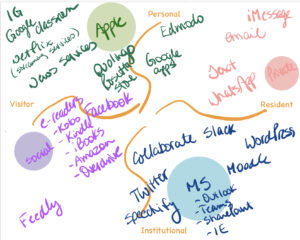
Depends on the time of day, the day of the week, and the hat I’m wearing. If it’s a weekday morning, I’m at work, and I have enough coffee in me, I’m on that blue/pink Resident/Institutional side where I’m creating using those Microsoft tools we’re tied to at work. If it’s the evening, it’s the other diagonal at Personal/Visitor in green and purple where I’m using more Apple product and connecting with friends and family, consuming news, books, school updates, and language learning resources, rather than producing.

At least that’s how the past couple of years have gone. If I go further back, my workday is producing. My evenings are producing AND consuming. Looking at this graphic, I realize how much I’ve been on autopilot and consuming, rather than consuming, THEN PRODUCING. I’m looking forward to shifting this and expect to redo this in a year or so and see what’s changed. For me, this was a good exercise to more consciously do something with what I’m consuming, rather than just let it marinate in my brain. I was also surprised to see that my Personal-Institutional divide was so starkly divided by technology hardware brand. I’d like to look into that more.